Author: Kamil

  • The EU AI Act Starts Tomorrow. Most Companies Will Label the Wrong Things

    The EU AI Act Starts Tomorrow. Most Companies Will Label the Wrong Things

    Article 50 of the EU AI Act applies from 2 August 2026. Most companies will respond in one of two ways: slap “AI-generated” on everything that came out of Canva, or do nothing and hope nobody checks. Both are wrong. The rule is narrower than people assume, but in one specific place it cuts far deeper. Fines: up to EUR 15 million or 3% of global turnover, whichever is higher.

    Why this applies to companies that “don’t do AI”
    AI Act 2 sierpień 2026

    The AI Act sorts AI systems by risk level. Prohibited practices sit at the top. Below them, high-risk systems – the ones used in recruitment, credit scoring, medical diagnostics, critical infrastructure. Those carry the heavy machinery: conformity assessments, technical documentation, CE marking. Most marketing and e-commerce businesses will never touch that category.

    Article 50 works differently. It doesn’t ask about the system’s risk level. It asks about the situation you’re using it in.
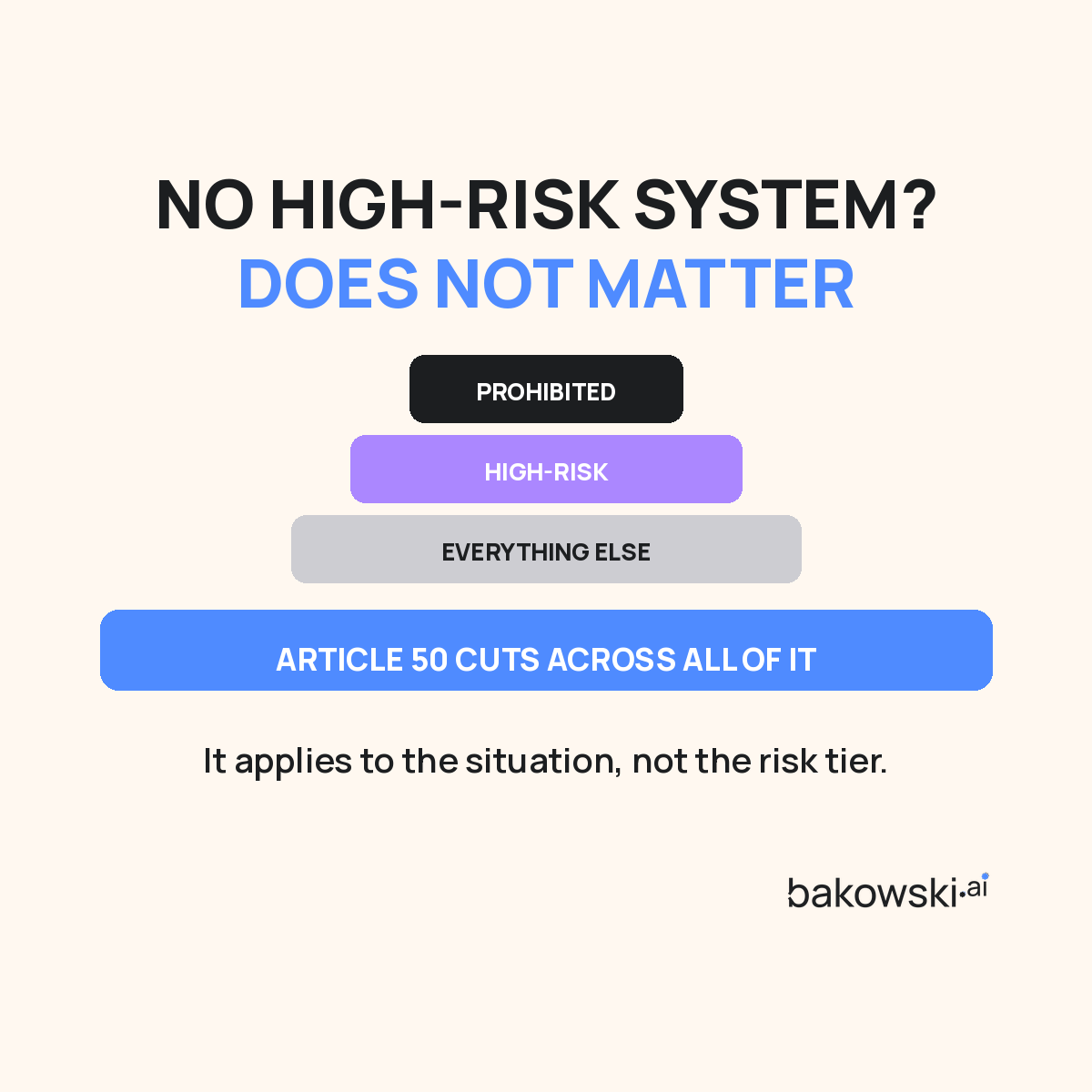
    That’s why a company with zero high-risk systems can carry full Article 50 obligations – because it put a chatbot on its website or published an ad made in a video generator. According to Compliance Checker data from artificialintelligenceact.eu, transparency obligations are the second most common reason a business falls under the AI Act, right after AI literacy. They affect roughly a third of organizations surveyed.

    This is a horizontal rule. It cuts across every industry and every risk tier.
    Four situations. Only one is actually yours

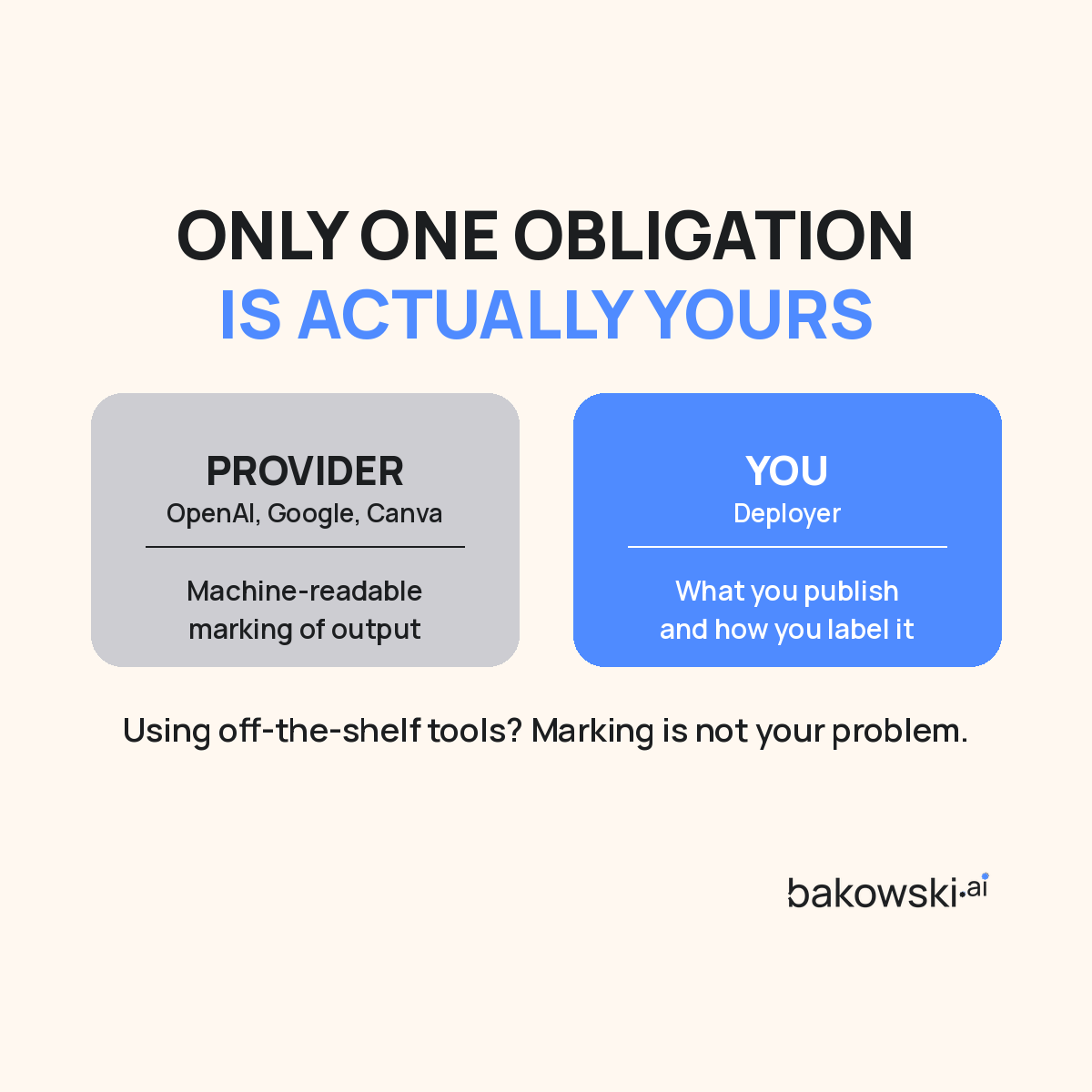
    This is where the confusion starts. Article 50 covers four situations, but they don’t all land on the same party. Two are obligations of the tool’s provider. Two belong to the deployer – the business using the tool.

    Situation one: AI interacts directly with a person. Chatbot, voice assistant, phone agent. The user has to know there’s a machine on the other end. That’s the provider’s obligation – whoever built the system and released it under their own brand.

    Situation two: AI generates synthetic content – text, image, audio, video. The output must carry machine-readable marking so detection tools can identify it. Again, the provider’s job. Specifically: OpenAI, Google, Canva, Grammarly. Not you.

    Situation three: AI recognizes emotion or performs biometric categorization. Anyone exposed to the system must be informed. This one falls on the deployer, but it affects a narrow set of businesses.

    Situation four: deepfakes, and text published to inform the public on matters of public interest. Deployer’s obligation. And this is the one situation almost every content-publishing company lands in.

    The practical takeaway: if you’re only using off-the-shelf AI tools, technical output marking isn’t your problem. What you publish, and how you caption it, is.

    Deepfakes: the definition, and a five-second test

    Under Article 3(60), a deepfake is AI-generated or AI-manipulated image, audio, or video content depicting a real person, place, object, or event, which would falsely appear authentic.

    Everything turns on “authentic.” The question isn’t whether you used AI. It’s whether the viewer could take the material as a record of something that actually happened.
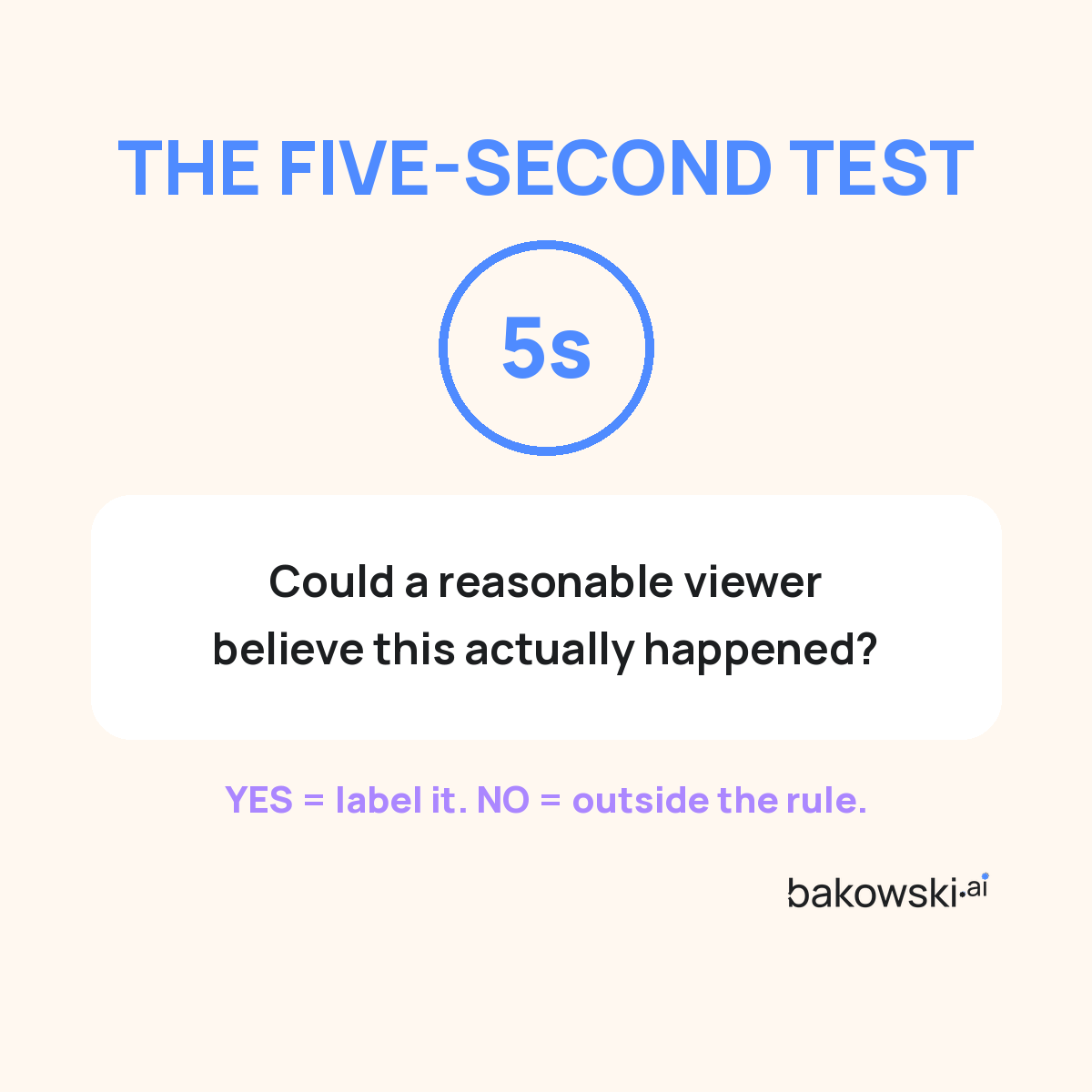

    Hence the test: could a reasonable, attentive viewer believe this really occurred?

    If yes, label it. If the scene is obviously fantastical or physically impossible, it falls outside the deepfake definition entirely. The Commission gives explicit examples: dragons, humans flying unaided, elephants driving cars. Separately, artistic, satirical, and fictional works get a lighter obligation – a disclosure that doesn’t spoil the work, not a badge stamped across the frame.

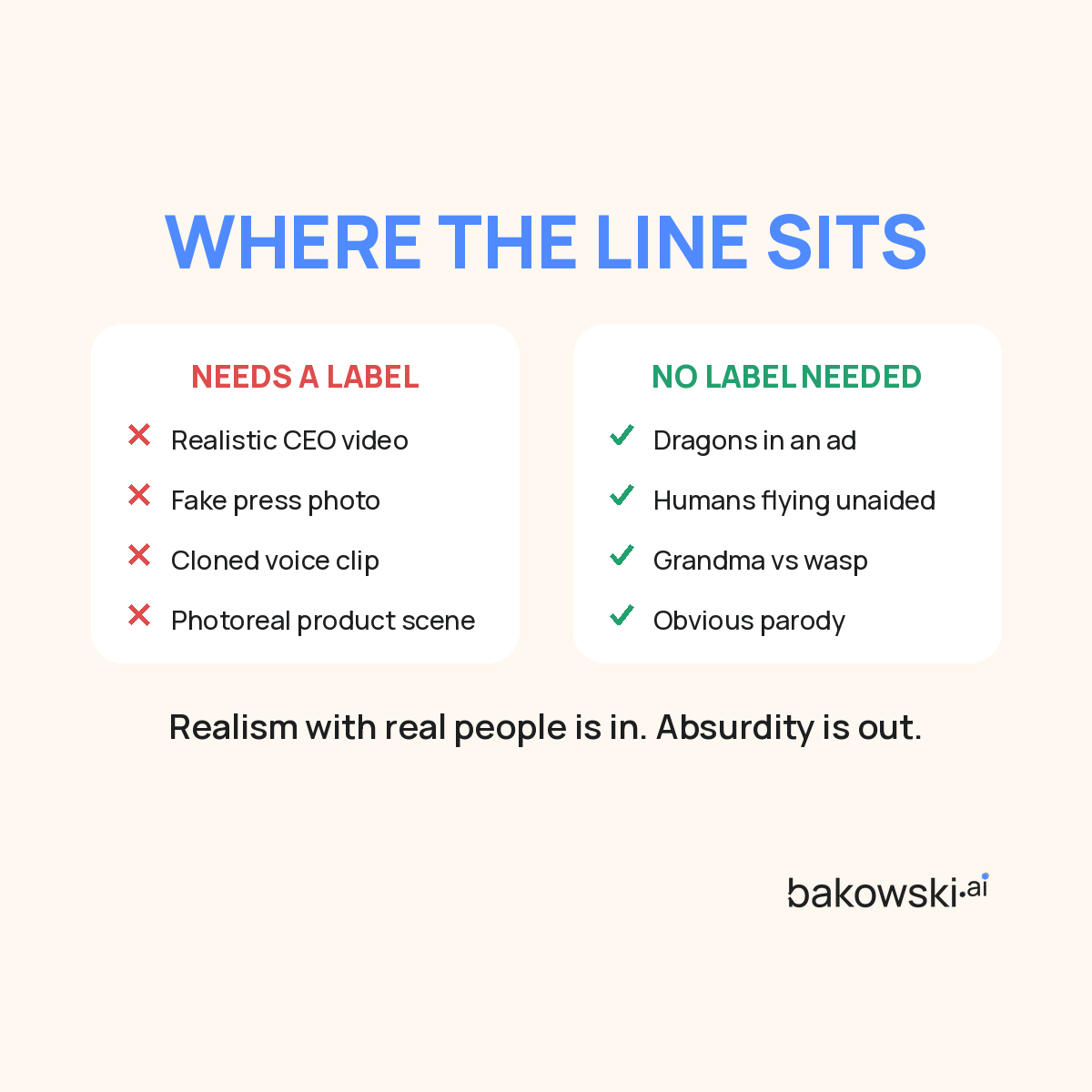
    Where the line actually sits:

    • Label it: a realistic video of a well-known CEO announcing a merger or layoffs. It looks like genuine footage, so it’s a deepfake.
    • Label it: a photo of a politician in a situation that never happened, styled like an ordinary press image.
    • Label it: a synthetic voice impersonating a real person in a clip that sounds like an authentic conversation.
    • Label it: a photorealistic render showing your product in a scenario that never occurred, presented as a standard product photo.
    • Don’t label it: an ad with a flying dragon or a person hovering unaided. Physically impossible, so outside the definition.
    • Don’t label it intrusively: obvious parody recognizable as satire. A discreet note, for example in the caption, is enough.
    A clean example of content entirely outside the risk zone: the short film “Grandma VS Wasp – Official 100% AI Made Story” from Higgsfield Creators, where a grandmother fights a wasp in full action-movie choreography. Nobody will read that as a record of real events, because people don’t duel wasps. On top of that, the creator declared it 100% AI right in the title. Absurdity plus explicit disclosure – two independent layers of protection.

    Text plays by entirely different rules
    This is the most misread part of the rule, because intuition says that if images need labels, text must too. It doesn’t.

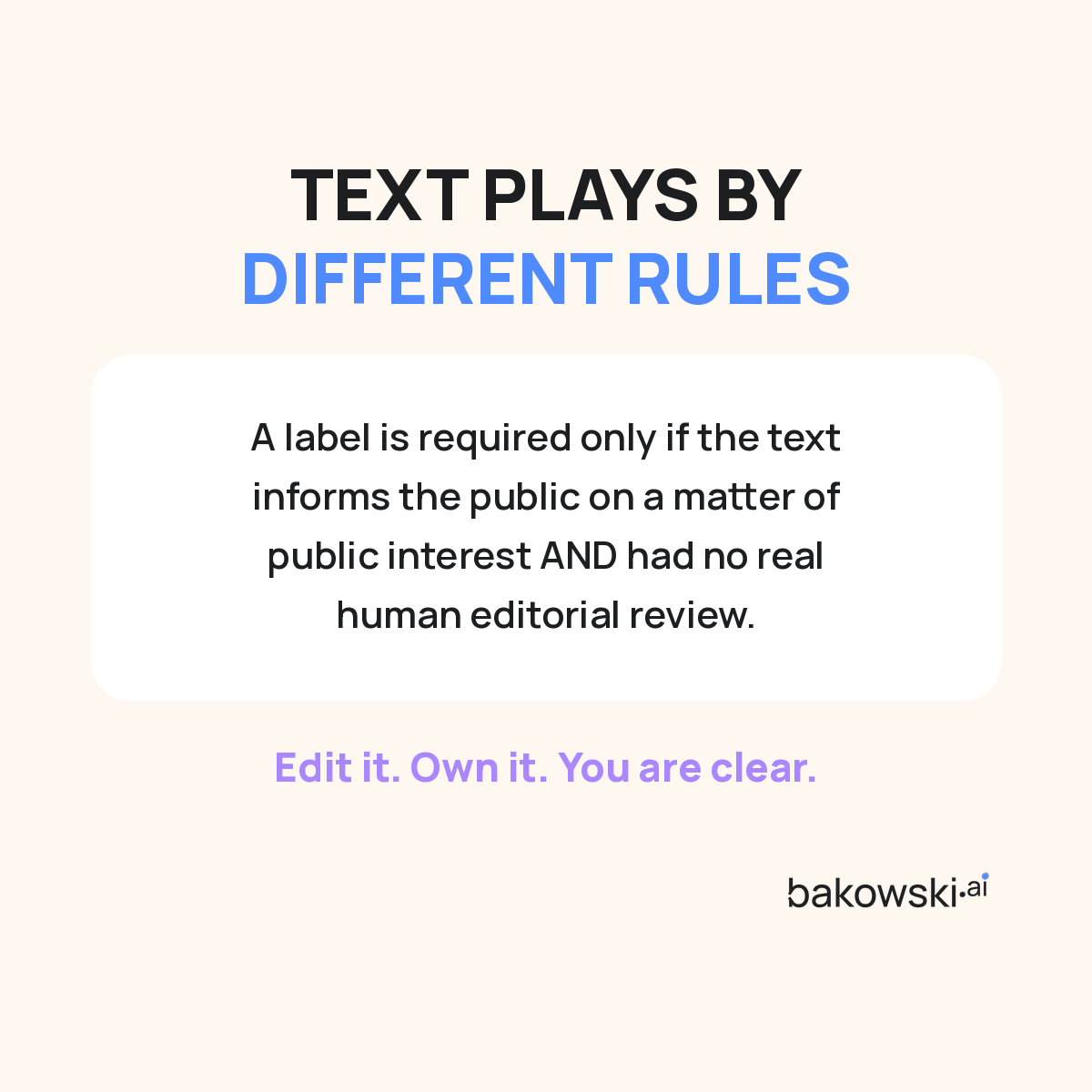
    The obligation applies only to text published with the purpose of informing the public on matters of public interest. The publisher’s purpose is what triggers it, not the topic itself. A news article, a public report, a statement on a societal issue – yes. A product description, a company post, a sales newsletter – no.

    On top of that, there’s a carve-out that lifts the obligation even from informational content: if the text went through genuine human review and a specific person or entity holds editorial responsibility, no label is required. The condition is that the review must be substantive. Clicking “approve” without reading doesn’t qualify.

    In practice: draft with AI, edit it, own it – you’re clear. Publish raw model output verbatim on a public-interest topic with no editorial process – disclose it.

    How to label so it actually works and doesn’t kill the message

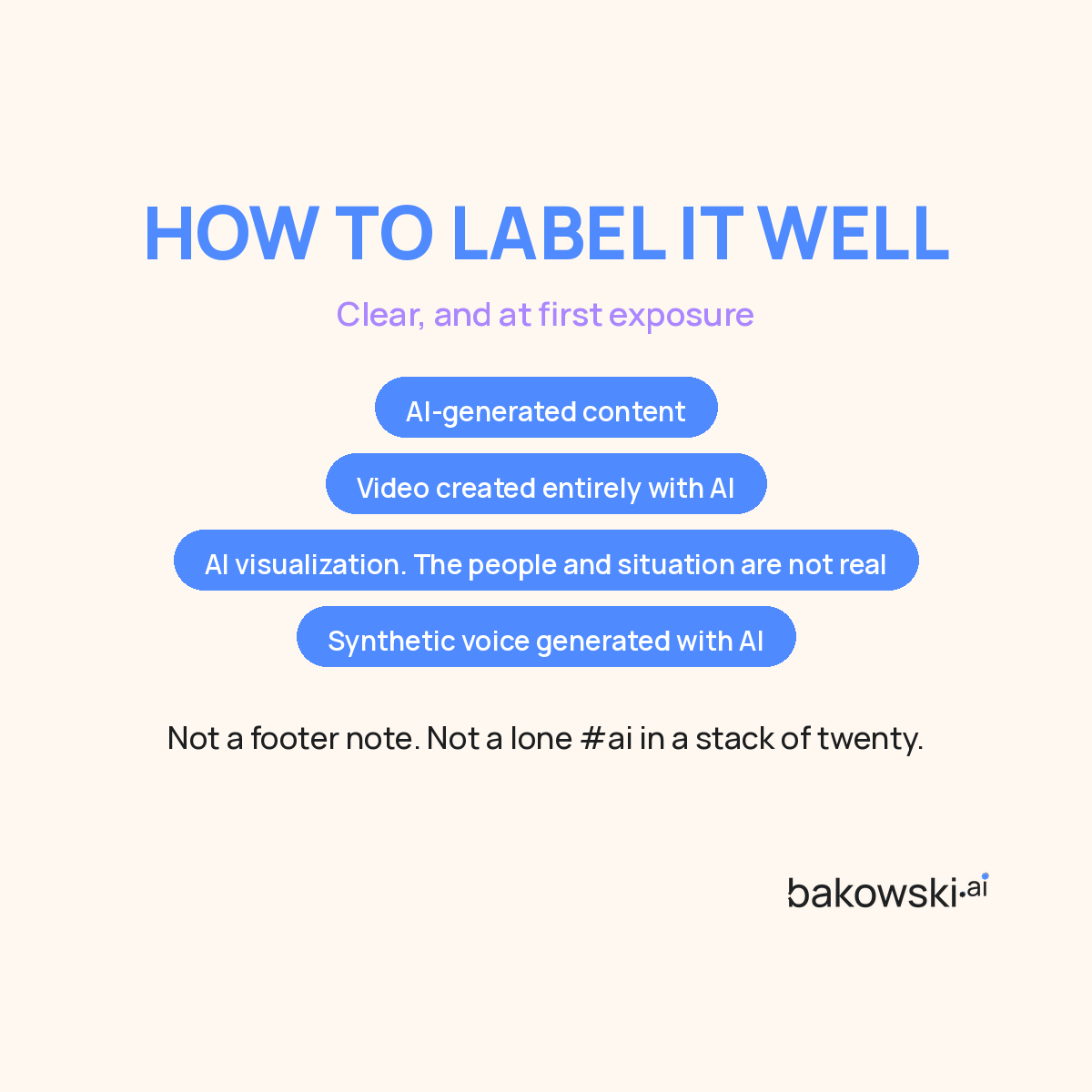
    The rule requires disclosure in a clear and distinguishable manner, at the latest on the recipient’s first exposure to the content. For video that means the start of the clip or a persistent badge. For audio, an audible notice. For images, a visible label.

    A Code of Practice is being finalized in parallel to standardize this, proposing a uniform visual “AI” label and a split between fully AI-generated and AI-assisted content. The Code is voluntary, but it will function as the practical benchmark for regulators.

    Wordings that meet the clarity threshold without sounding like a pharmaceutical warning:

    • “AI-generated content” – universal, neutral, works anywhere.
    • “Video created entirely with AI” – for content with no camera involved.
    • “AI visualization. The people and situation are not real” – best for realistic scenes involving people.
    • “Synthetic voice generated with AI” – for audio and voiceover.
    • “AI-generated concept image” – for product visualizations.
    AI Act EU -jak oznaczać

    What to avoid, because it fails the clarity test: small print in the site footer, a note buried in the terms, a lone #ai at the end of twenty other hashtags, a badge flashing for a fraction of a second. The principle is simple: if the viewer has to look for it, it isn’t a disclosure.

    Good news for marketing: transparency sells better than pretending. Brands that state plainly “made with AI” rarely lose trust. The ones that lose it are the ones caught hiding it.

    Pre-August content, and the question nobody asks: who’s accountable for agency work

    Two questions that decide, in practice, whether a company has a problem.

    Previously published material: if a piece was both generated and published before 2 August 2026, no retroactive labeling is required. But if it was created earlier and you publish it on or after 2 August 2026, the obligation applies normally. Publication date governs, not creation date. That has a direct consequence for content banks and scheduled campaigns – anything sitting in the publishing queue falls under the new rules.

    A separate transition period exists for providers: generative AI systems already on the market before 2 August have until 2 December 2026 to implement machine-readable marking. That’s an exception for tool builders, not for publishers.

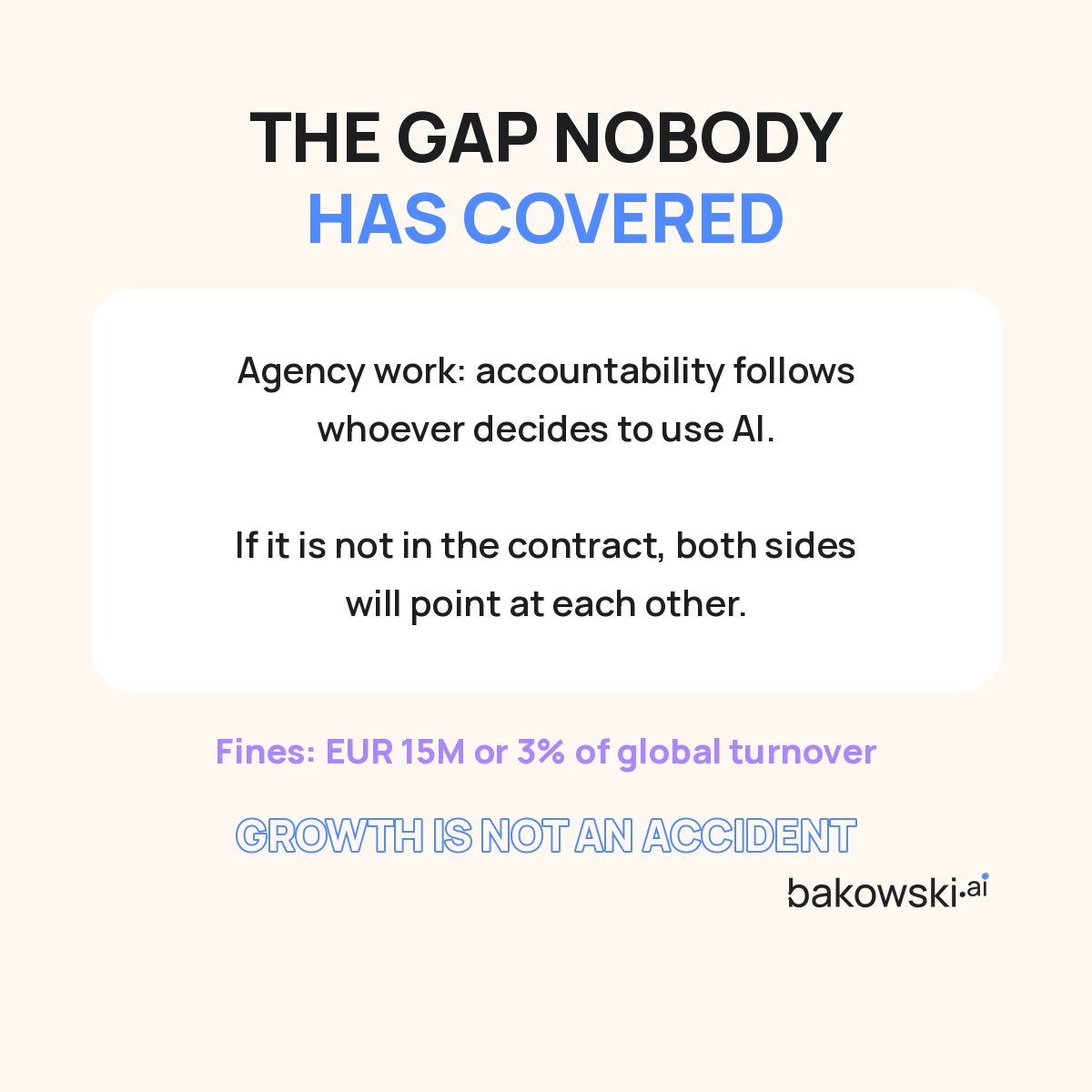
    Agencies and freelancers: accountability follows the actual decision to use AI. If an agency works strictly to your brief and under your direction, your company remains the deployer and you’re accountable for labeling. If the contractor is free to decide whether and how to use AI on the assignment, they become the deployer and the obligation moves to them.

    In practice, a content agency contract should now settle two things explicitly: who decides on AI usage, and who is accountable for labeling. Without that clause, the first time a regulator asks, both sides will point at each other.

    What this means for your business

    The AI Act doesn’t ban AI-generated content. It doesn’t tax creativity either. It forces one thing: that the audience knows when they’re looking at reality and when they’re looking at a simulation of it.

    For most companies the actual work is small but specific. This isn’t a quarter-long compliance program. It’s a review of three things: what you publish, who makes it, and how you sign it.

    The risk isn’t where companies are looking for it. Nobody gets fined for an unlabeled blog graphic. The fine comes from a realistic piece featuring a real person that went out with no indication it was synthetic – and from having nobody inside the organization who owns that process.

    Three things to remember

    The deepfake test is a credibility test, not a technology test. The question isn’t “did I use AI,” it’s “could someone take this as true.” Absurdity and fantasy sit outside the rule. Realism involving real people sits inside it.

    Human-edited text needs no label. The obligation covers only content published to inform the public, and it disappears when real editorial responsibility exists. The editorial process is your shield here, not a formality.

    Publication date settles old content, and the contract settles agencies. Anything going out on or after August 2 falls under the new rules regardless of when it was made. And accountability for labeling sits with whichever side decides on using AI.

    This rule doesn’t change what you’re allowed to create. It changes what you’re not allowed to leave unsaid. Growth is built on systems and deliberate decisions – and this is one you make once and write into the process.
    Note: this article is informational and does not constitute legal advice. Before implementing specific measures, confirm the final interpretation with your legal team or a lawyer specializing in AI regulation.

  • Siri AI at WWDC 2026: A Smart Strategic Bet, No Delivery Date, and Europe Left Out

    Siri AI at WWDC 2026: A Smart Strategic Bet, No Delivery Date, and Europe Left Out

    Apple unveiled Siri AI as the centrepiece of WWDC 2026. The vision is coherent, the architecture makes strategic sense – and there is one serious problem that matters for any business operating in Europe. For iPhone and iPad users in the EU, there is no launch date. No timeline. It is a planning constraint.

    What Apple is actually building

    Apple is not competing on model quality. It cannot win that race today.

    Apple is betting on something different: the place where AI operates.

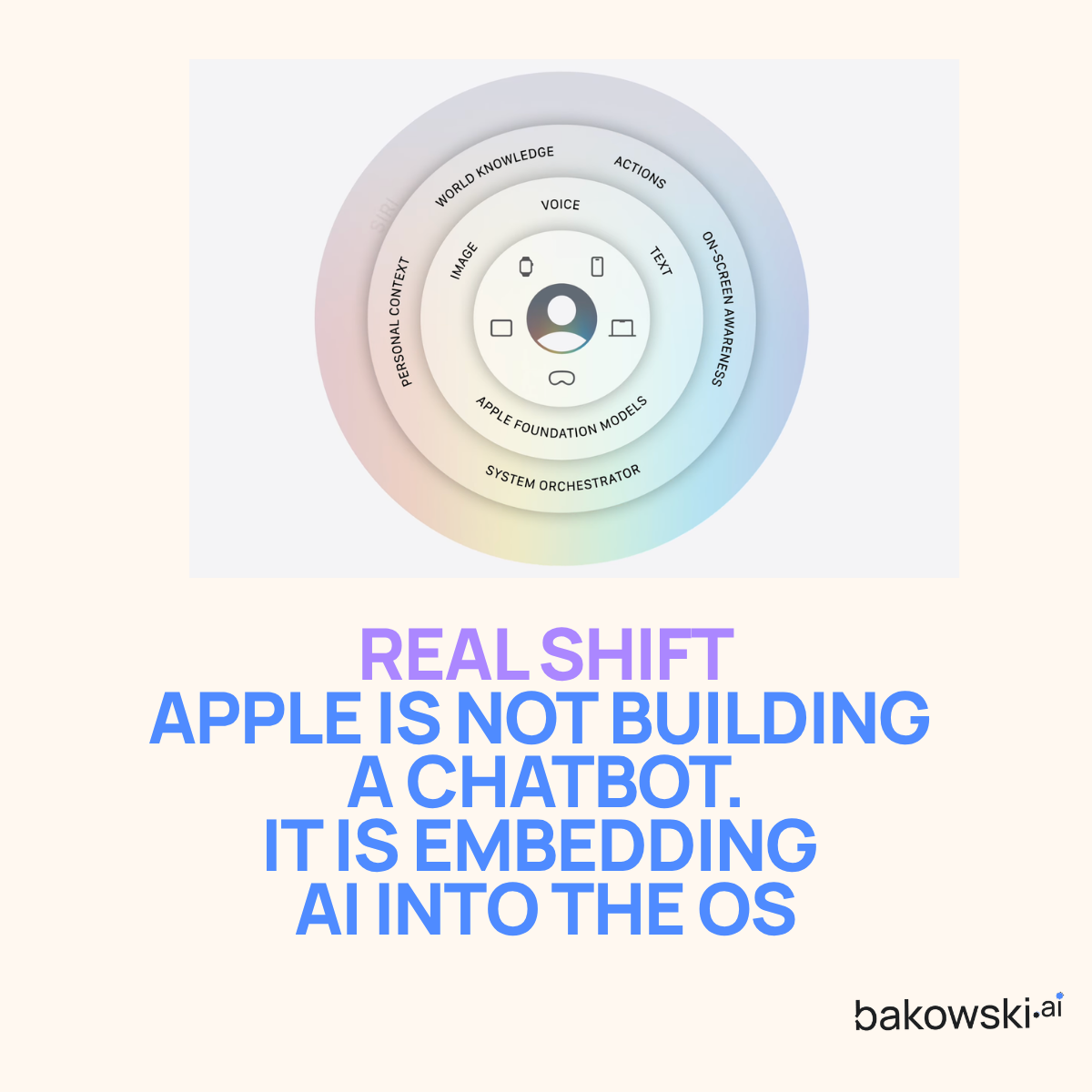
    The new Siri AI architecture is built around five capabilities: Personal Context Understanding, App Actions, On-screen Awareness, Visual Intelligence, and a new System Orchestrator. The idea is straightforward. Siri should stop being a voice interface that frequently failed on basic queries. It should become an AI layer embedded across iOS and macOS – one that knows your files, messages, emails, photos, calendar, and what is on your screen right now. And that acts on that knowledge, rather than just returning answers.

    This is a positioning shift, not a feature update.

    Personal Context: Apple’s core strategic bet

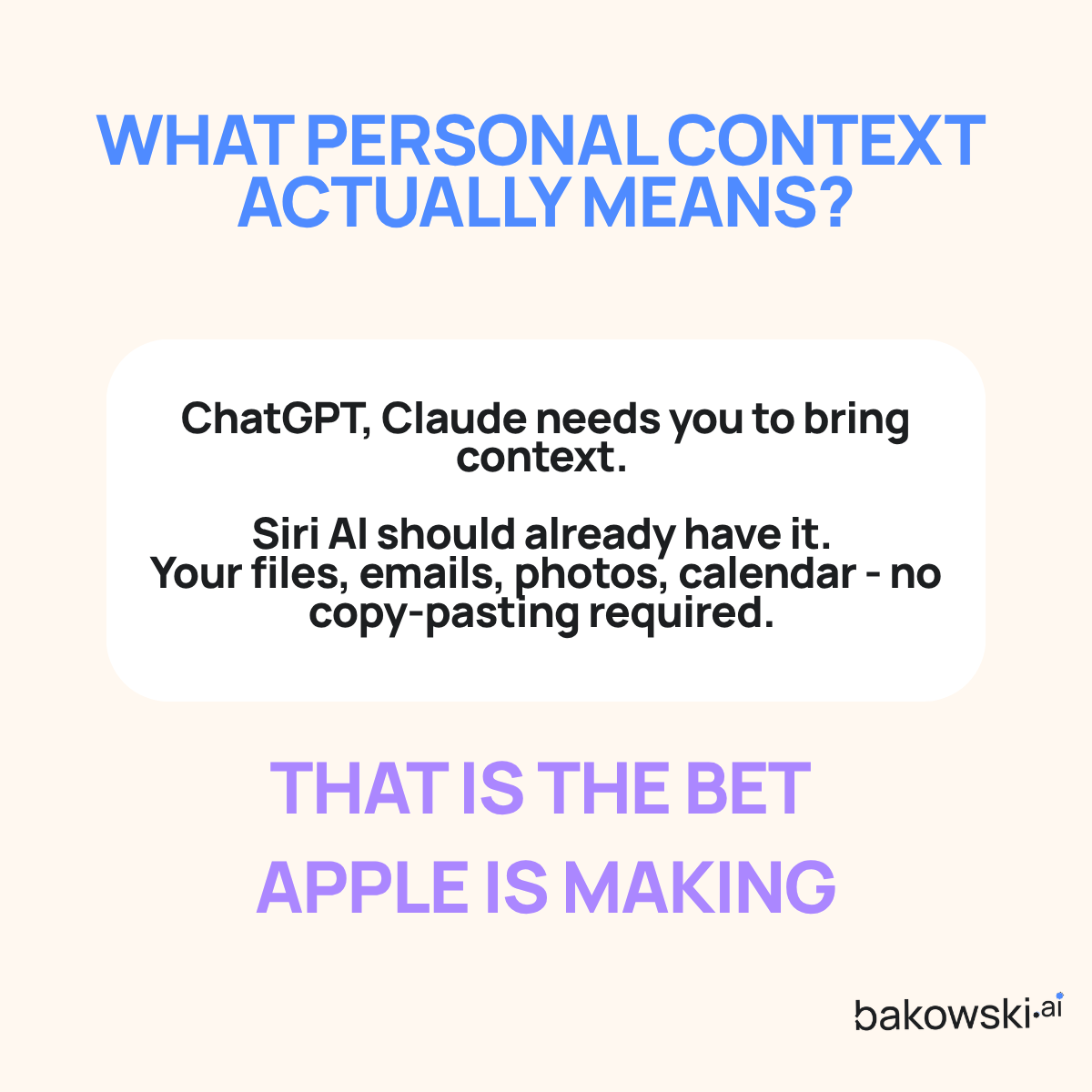
    ChatGPT, Gemini, and Claude are powerful. They share one structural constraint: you bring the context to them. Copy-paste the email. Upload the file. Describe the situation from scratch.

    Apple wants to change that. Siri AI is designed to operate on data already on your device. Ask: “Will this backpack work for a three-day trip?” – a properly integrated Siri should already know where you are going, what the forecast looks like, and what you have in your notes. Because that information exists somewhere in your system.

    The WWDC demo showed a flight booking scenario: a reservation number visible on screen during a live call. Siri pulls the relevant data in context, at the right moment, without the user copying anything or switching between apps.

    If this works as shown – it changes how AI enters the daily workflow. Not as a tool you open separately to type prompts. As a layer of the operating system that works where you already are.

    App Actions and Spotlight: AI that does things

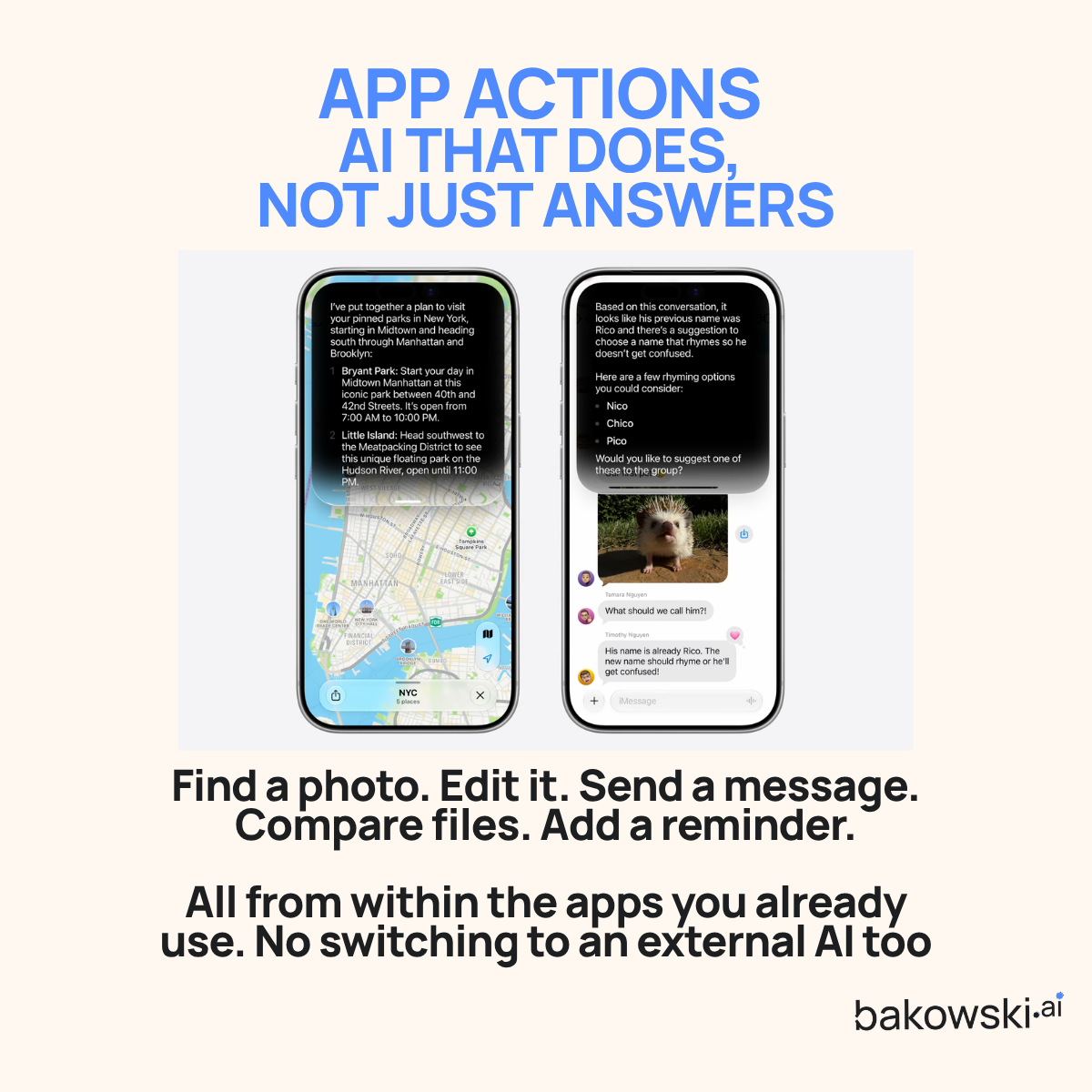
    App Actions is the second key element. Siri AI is designed to act inside applications – find and edit a photo, send a message, add a reminder based on earlier conversation context, compare files on Mac – not just surface an answer.

    On macOS, Spotlight now includes “Ask Siri.” Select a group of documents, ask for a comparison or summary – without switching to an external AI tool.

    There is also a standalone Siri App with conversation history and cross-device continuity. As a chatbot alone, this is not a breakthrough – ChatGPT and Gemini have had this for a long time. But Personal Context combined with App Actions and System Orchestrator is potentially a different category of integration than any external AI application can offer. The depth of system access is the differentiator, not the model.

    Google Gemini at the foundation

    One fact that signals clearly where Apple stands in the AI model race.

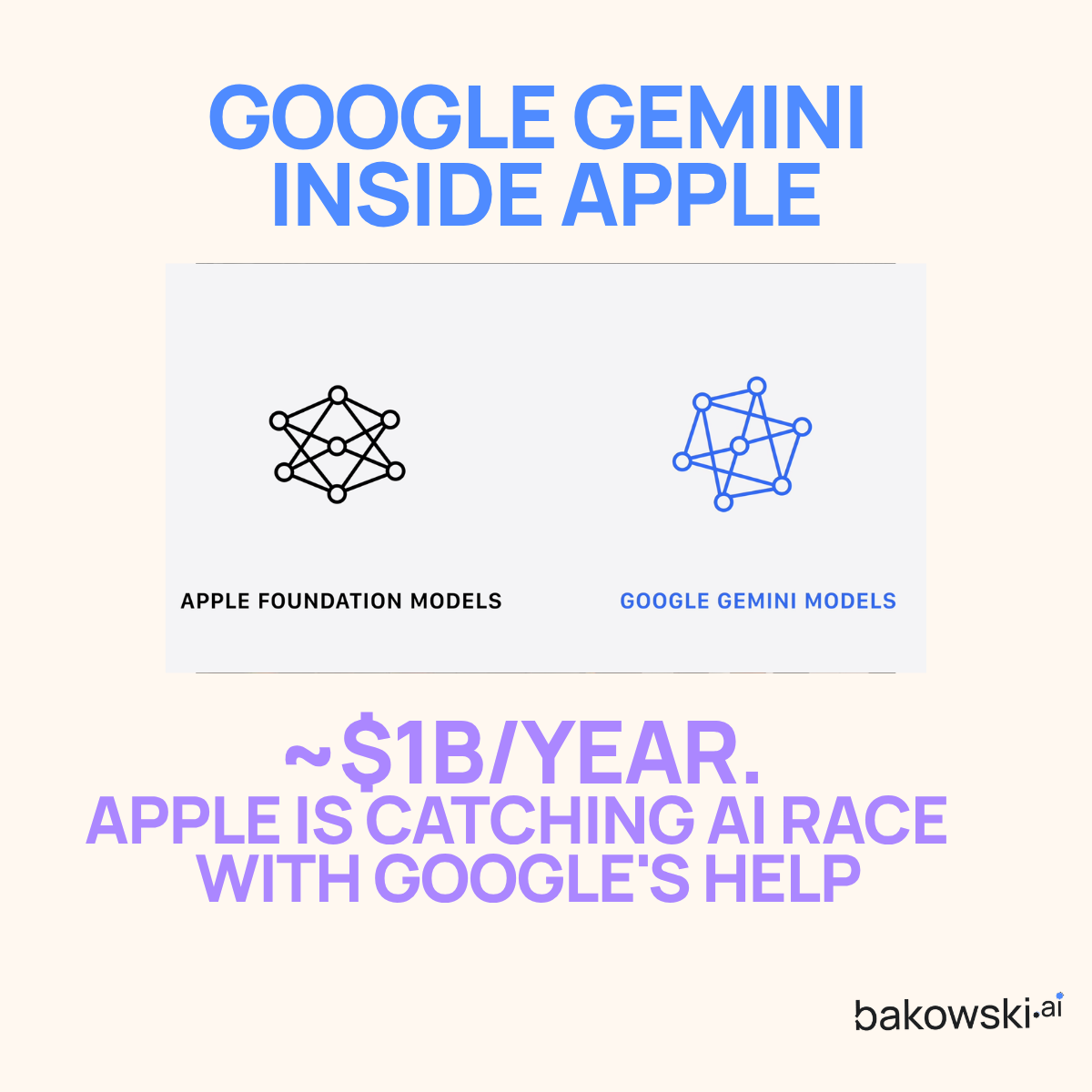
    The next generation of Apple Foundation Models was developed in collaboration with Google’s Gemini technology. Both companies confirmed this officially. Apple signed a multi-year deal to use Google’s Gemini models and cloud infrastructure, with the arrangement costing Apple approximately $1 billion per year according to Bloomberg and MacRumors. Apple states that the final deployed Foundation Models are Apple’s own code – Gemini was used in training and collaboration, not deployed directly to devices.

    This is a pragmatic decision. It may be the right one for speed to market. But the signal is clear: Apple is not leading in AI model development today. Apple is betting on integration, privacy, and Personal Context – and partnering with Google to accelerate.

    No Siri AI in Europe: real business implications

    This is the most significant problem to emerge from WWDC 2026.

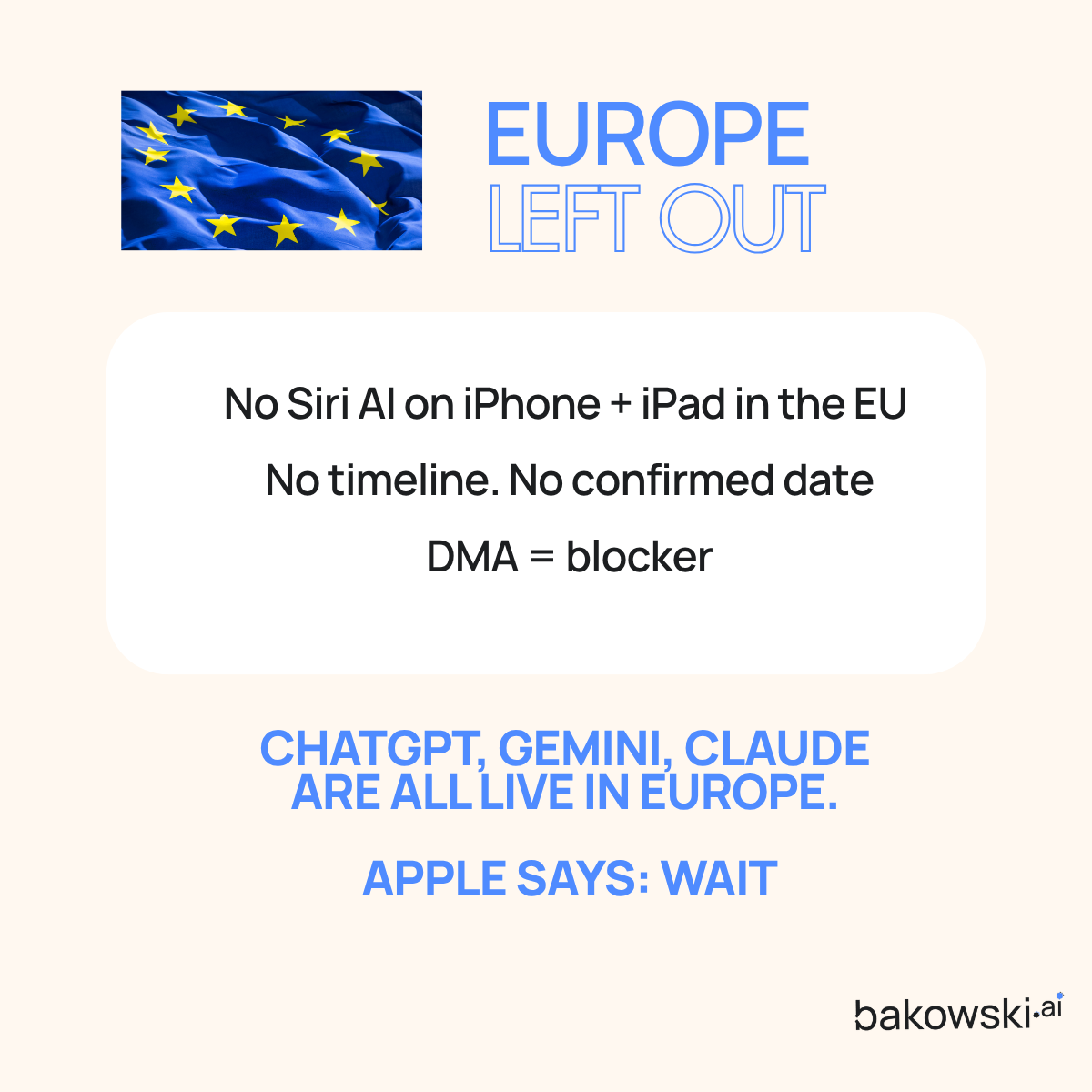
    When iOS 27 and iPadOS 27 ship to users later this year, Siri AI will not be available on iPhone and iPad in the European Union. Apple said Siri AI will not be available in the EU until it can find a path forward for regulatory approval, with EU regulators not accepting any of Apple’s proposed solutions for bringing Siri AI to the EU while supporting other virtual assistants.

    Craig Federighi stated: “We’re deeply disappointed that our EU users won’t have Siri AI on iPhone or iPad when we share our new software releases later this year.”

    Siri AI will be available on macOS 27 and visionOS 27 in the EU. iPhone and iPad in Europe – not yet, with no confirmed date.

    For individual users in Europe: frustration. For businesses planning AI workflows on Apple hardware: this is a genuine planning constraint.

    ChatGPT operates in the EU. Gemini operates in the EU. Claude operates in the EU. ChatGPT, Gemini, Claude, Perplexity, and other AI services remain available through apps or the web in Europe, while EU iPhone users who cannot use Apple’s new Siri AI may continue turning to third-party tools.

    Apple is asking EU users to wait – with no confirmed timeline.

    If you are building an AI tooling strategy for a European team on Apple hardware, factor this in. Native Siri AI on iPhone in Europe may not arrive in 2026.

    Business takeaways

    Apple did not show a revolution at WWDC 2026. Apple showed a coherent catch-up strategy – executed with Google’s help and significant availability gaps.

    The strategy is sound. Winning AI not by having the best model, but by having the deepest integration with the user’s personal context at OS level – that is a defensible position benchmarks cannot dismantle. If Personal Context and App Actions deliver what was demonstrated, Apple builds an advantage that OpenAI cannot simply copy.

    Three things to factor into planning:

    Personal Context is the biggest promise and the biggest open question. Demos always look good. The real test is performance with actual data in real workflows.

    No Siri AI on iPhone in the EU is a genuine constraint for European teams planning AI in an Apple environment. No timeline for when this changes.

    The Google partnership signals where Apple stands in the model race. Pragmatic – but it shows who is leading AI infrastructure today.

    Siri AI could become the most consequential change in iPhone history. But only if Apple delivers the integration. And only when it reaches Europe.

  • Microsoft Showed the Future of AI Agents at Build 2026. The Bill Starts at Over €6,000 Before a Single Agent Does Anything

    Microsoft Showed the Future of AI Agents at Build 2026. The Bill Starts at Over €6,000 Before a Single Agent Does Anything

    Microsoft Build 2026 had one central message: agentic AI is ready for enterprise. New tools, new architecture, new hardware. The direction is right – Microsoft is all-in on AI agents as the future of work. But buried in the keynote was something that didn’t get much stage time: the cost model. That’s the part that determines who actually deploys agents versus who walks away with a AI that is used by none.

    First, a Fair Word About What Microsoft Is Getting Right

    The direction is strategically sound. AI agents that autonomously execute tasks and collaborate with other agents aren’t hype – they’re the next stage of AI in business. At Build 2026 Microsoft also announced the Surface RTX Spark Dev Box – a compact developer PC with NVIDIA’s RTX Spark chip, 128GB RAM, 1 petaflop of AI compute, capable of running 120B+ parameter models locally without paying per API call. Hardware, software, infrastructure – Microsoft is thinking about the full stack.


    Four Layers Microsoft Is Building Agents On

    Build 2026 wasn’t a collection of disconnected announcements. It was a coherent architecture across four layers.

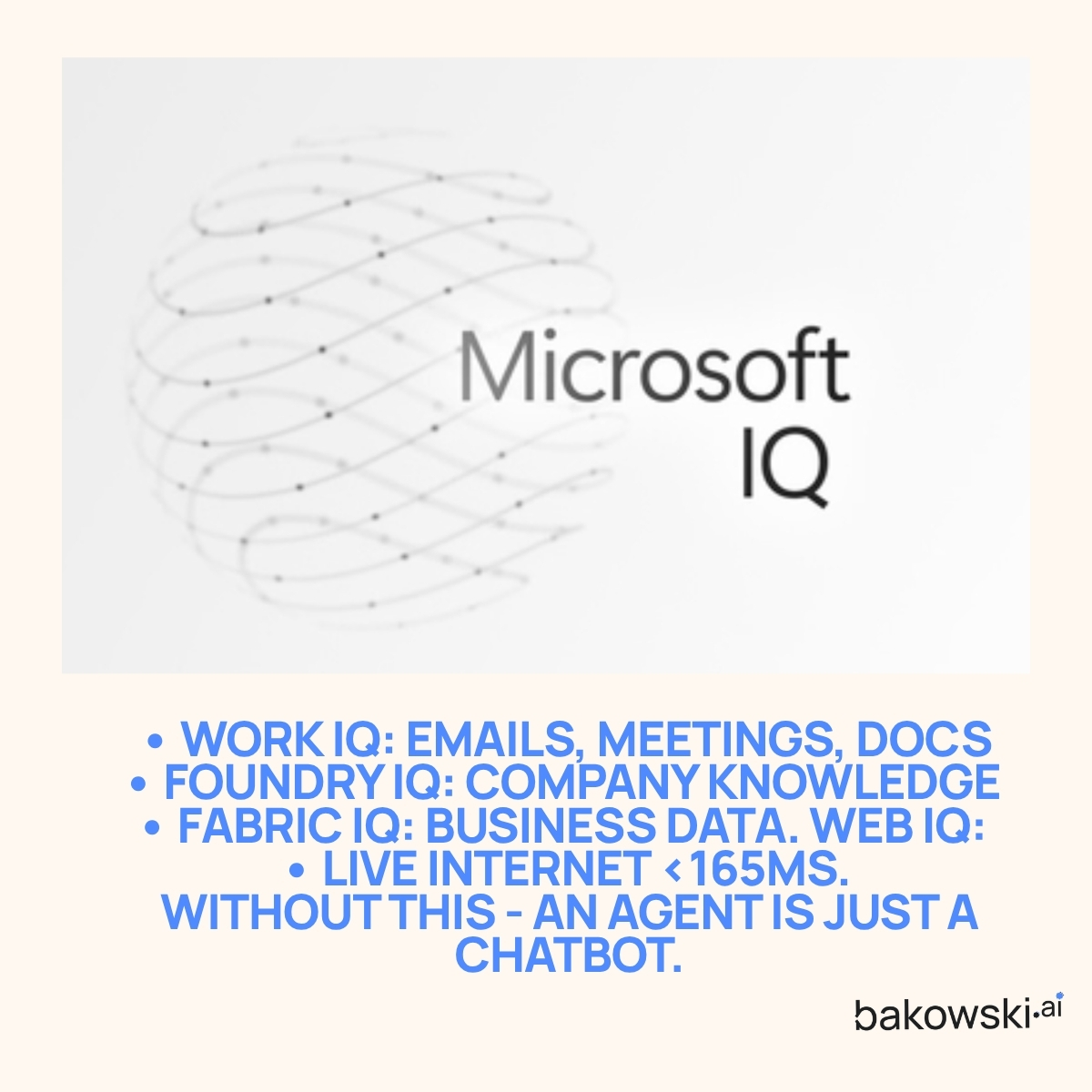
    1. Microsoft IQ – The Organizational Intelligence Layer

    Microsoft IQ is a shared context layer for all agents in the Microsoft ecosystem – the company’s memory that agents draw from. Four components: Work IQ (emails, meetings, documents, relationships in M365 – GA June 16), Foundry IQ (databases, files, Azure SQL and external sources – GA now), Fabric IQ (structured business data and semantics), Web IQ (real-time internet data, sub-165ms latency). Without Microsoft IQ, an agent is a chatbot. With it, the agent understands how your organization works.

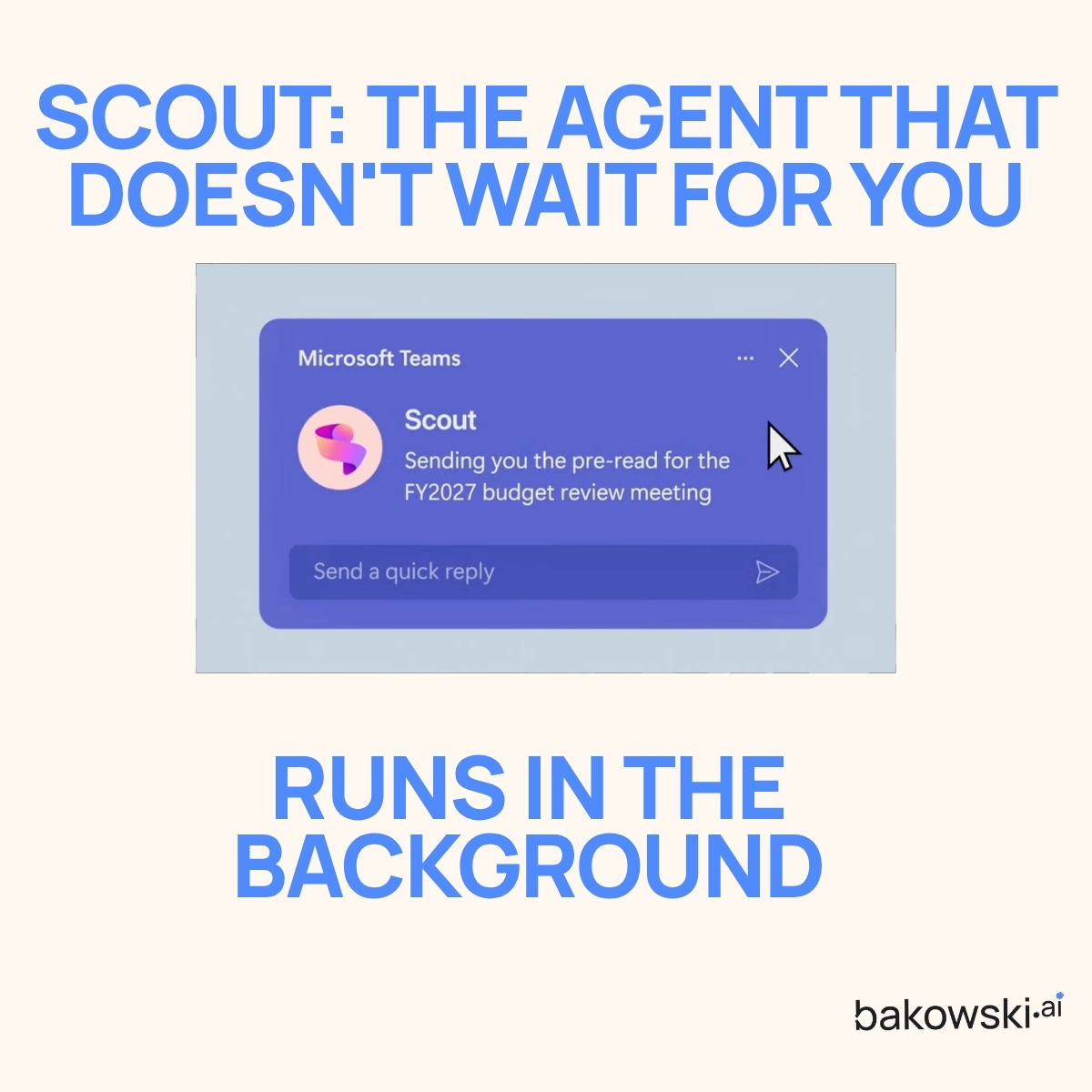
    2. Scout and Autopilots – The Agent That Doesn’t Wait for a Prompt

    Scout is Microsoft’s first Autopilot agent – fundamentally different from previous assistants. It runs in the background without waiting for a user prompt. It has its own governed Entra ID identity, meaning every action is attributed to an auditable actor – not an anonymous service account. Connects to Teams, Outlook, OneDrive, SharePoint, and the local Windows desktop.

    Practical example: ask Scout to prepare for your quarterly review. It scans Outlook, pulls data from Excel in OneDrive, drafts a PowerPoint, and schedules a Teams meeting – without you switching between a single app. Built on OpenClaw (open-source local AI agent framework). Available now through Microsoft’s Frontier Program. Requires: Frontier enrollment, Intune configuration, GitHub Copilot license.

    3. MXC and the OS Layer – Windows as Agent Runtime

    Microsoft Execution Containers (MXC), now in preview, create sandboxed environments for agents at the Windows OS level. Configure requirements once – Windows enforces them everywhere agents run. OpenClaw on Windows is the agent runtime integrated with MXC: the agent has its own identity, can execute code and access files – only within IT-defined security policies. For IT teams: no more manually configuring isolation for each agent.

    4. MAI – Microsoft’s Own Models

    Microsoft launched 7 in-house AI models under the MAI brand. Flagship: MAI-Thinking-1 – Microsoft’s first reasoning model, trained from scratch on clean, commercially licensed data with zero distillation. Alongside this, Claude (preview) and GPT-5.5 (GA the next day) joined Foundry. Strategy: be the platform, not just the model provider.

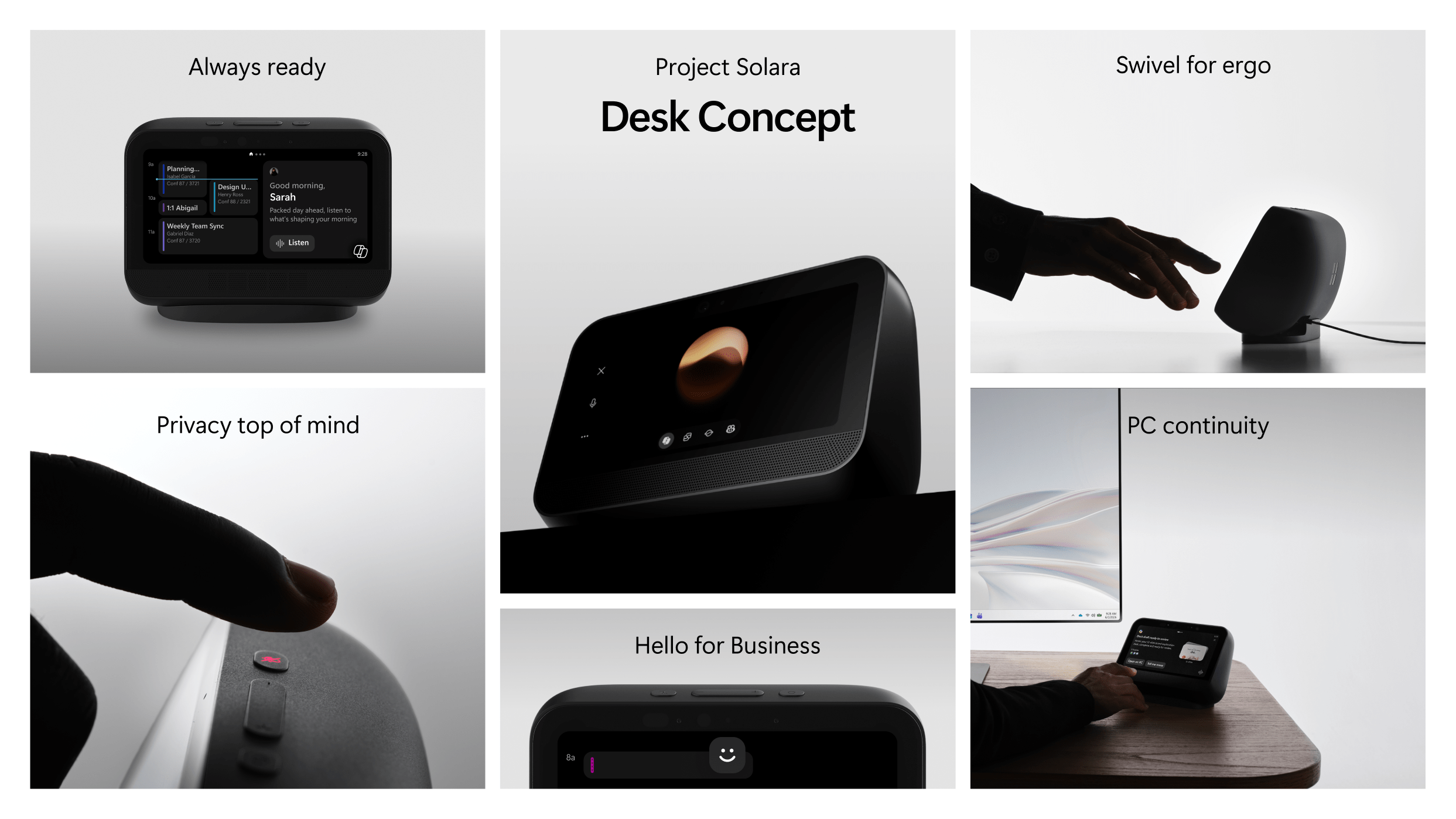
    5. Project Solara – An Android-Based OS for Agent-First Devices

    The boldest thing from Build 2026: Microsoft built a new operating system – not on Windows, but on Android Open Source Project (AOSP). Project Solara is a chip-to-cloud platform for devices where an AI agent is the primary interface, not apps. Building a new device category historically meant rebuilding the entire stack from scratch. Solara changes that – the agent dynamically adapts its interface to any screen or modality.

    Two concept devices: a wearable AI badge on Qualcomm hardware and a desk companion on MediaTek silicon. Piloted with Best Buy, CVS Health, Levi’s, and Target. This isn’t consumer hardware – it’s an enterprise platform for companies building purpose-built AI devices. The devices act as windows into cloud-hosted agents, not standalone computers.


    Copilot Credits – The New Billing Model for Agents

    At Build 2026, Microsoft unified agent billing under Copilot Credits – credits burned every time an agent does something. Copilot Studio is sold as a tenant-wide license. Entry pack: 25,000 credits for €185/month (approx. €0.007 per credit). Key distinction: internal B2E agents for licensed Copilot users consume no additional credits. External agents (customer-facing, website, app) do.


    The Hidden Bill – Over €6,000 Before an Agent Does Anything

    Scout, Microsoft IQ, and the full agent platform are Enterprise-only – unavailable in Microsoft 365 Business plans, which are designed for companies up to 300 users and offer a simplified feature set without advanced compliance or agent management capabilities.

    Copilot and agents aren’t standalone products. They’re add-ons requiring an M365 Enterprise base license. A quick guide to M365 Enterprise tiers:

    • M365 E3 (€34.90/user/month) – standard enterprise package: Word, Excel, Teams, Exchange, basic security, Entra Plan 1.
    • M365 E5 (€55.22/user/month) – everything in E3 plus advanced security (Defender, Sentinel), compliance (Purview), Power BI Pro. For regulated industries.
    • M365 Copilot Enterprise (€26.00/user/month) – the add-on that unlocks AI in apps, agent access, and Microsoft IQ.

    The numbers for 100 users on E3 + Copilot Enterprise:

    ComponentPrice100 users
    M365 E3 (base)€34.90/user/month€3,490/month
    Copilot Enterprise (AI add-on)€26.00/user/month€2,600/month
    TOTAL BASE€6,090/month

    Before an agent completes its first task – the organization pays over €6,000 per month. Annualized: €73,080.

    E5 + Copilot: €55.22 + €26.00 = €81.22/user/month x 100 = €8,122/month before the first credit.

    On top: external agents at scale. Five active agents across departments: estimated €2,750-5,500/month in Copilot Studio credits alone. Total for a 100-person company with a full agent platform: approximately €9,000-11,500/month. Plus Azure compute (Azure subscription required), Azure OpenAI tokens for advanced models, SharePoint Premium for document processing.


    Where It Makes Sense, Where the Trap Is

    Where it makes sense now:

    • Organizations already on E3/E5 with Copilot – base cost is in budget, internal B2E agents cost zero additional credits.
    • Internal automations: IT helpdesk, HR onboarding, knowledge base – immediate value, no extra invoice.
    • Scout for E5 + Purview organizations – priority access and security environment already in place.

    Where the trap is:

    • Companies looking at €185/month for Copilot Studio without seeing the €6,000+ base underneath.
    • External agents at any scale – every customer conversation burns credits.
    • Fragmented invoicing – M365, Azure, and Copilot Studio arrive on three separate bills. FinOps Foundation State of FinOps 2026 (1,192 practitioners, $83B annual cloud spend) lists AI cost visibility as the number one challenge.

    What This Means for Your Business

    First: what do you already have. On E3/E5 with Copilot? Start with internal agents – best value-to-cost ratio available now.

    Second: where are your end users. Agents for employees carry different economics than agents for external customers. Internal – included. External – the meter runs.

    Third: who manages the AI budget. Copilot Credits is a meter. IT can set spending limits at tenant, group, and user level. Configure it before the invoices arrive.

    What This Means Microsoft built the infrastructure. Now every organization needs to decide whether they can afford to plug in – and where to start.

  • Google Is Taking Over E-Commerce – From Traffic to Transaction

    Google Is Taking Over E-Commerce – From Traffic to Transaction

    At I/O 2026, Google announced three things that together redesign the foundation of e-commerce. This is not about a new ad format or better shopping feeds. It is about owning the full purchase journey – from the first search to checkout. If you run an online store, you need to understand this now.

    UCP – The Open Standard That Does for E-Commerce What HTTP Did for the Web

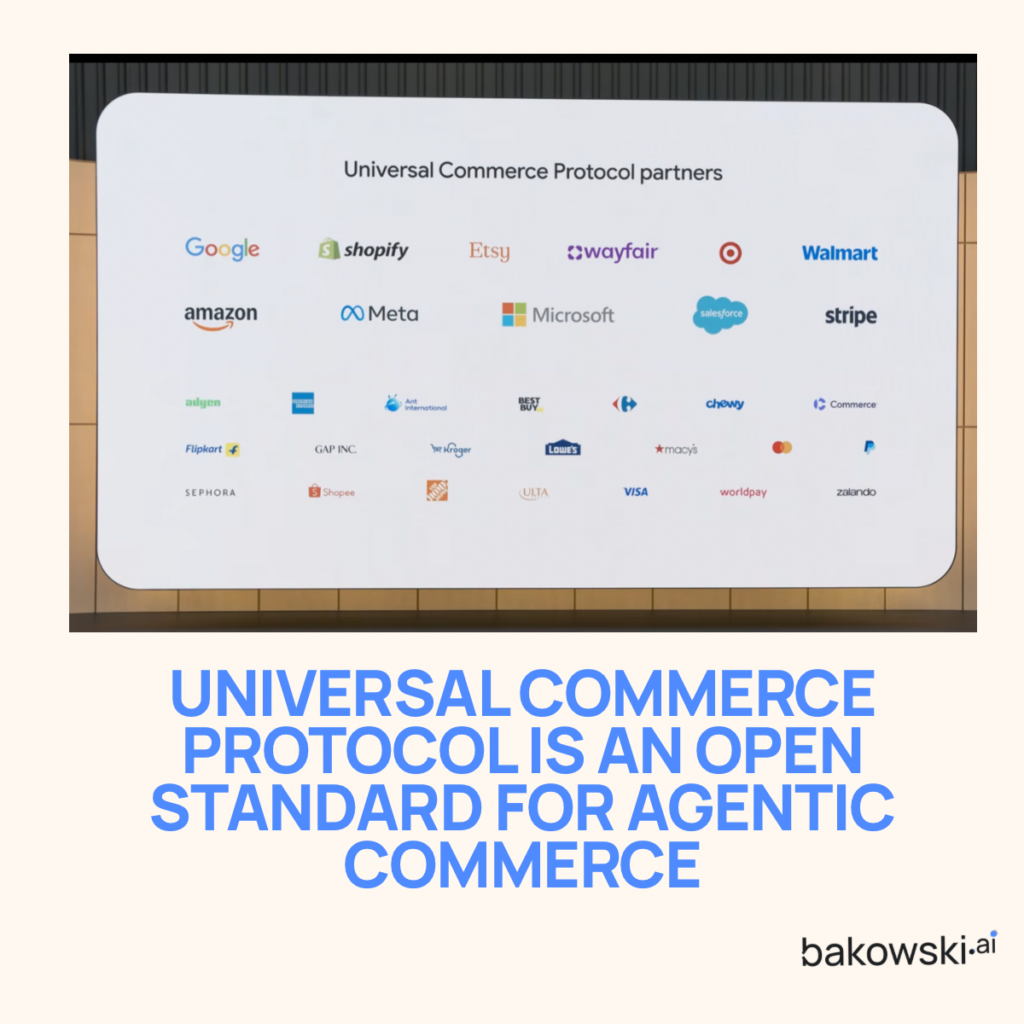
    Universal Commerce Protocol is an open standard Google first announced in January 2026 and fully deployed at I/O 2026. UCP creates a shared language for AI agents and commerce systems – covering product discovery, cart management, checkout, and post-purchase flows in one standardized protocol.

    Partners already on board include Amazon, Shopify, Meta, Microsoft, Salesforce, Stripe, Walmart, Target, Wayfair, Macy’s, Visa, Mastercard, and dozens more. This is not a pilot program. It is infrastructure entering the mainstream.

    For merchants: UCP supports integration via API, Agent2Agent (A2A), and MCP. The brand stays the merchant of record – Google does not take over the transaction, it facilitates it. But who controls the surface where the customer buys matters enormously.

    AP2 – An Agent That Pays on Your Behalf, Within Your Rules

    The Agent Payments Protocol (AP2) is Google’s payment layer for AI agents. It runs on cryptographically signed contracts called “Mandates” – an agent can complete a payment only within limits the user defines.

    Version v0.2.0, released in April 2026, introduced “Human Not Present” payments – an agent can buy a limited-release ticket the moment it goes on sale, without you sitting at a screen. Google has donated AP2 to the FIDO Alliance, signaling it wants an industry-wide standard, not a proprietary tool.

    Universal Cart – One Cart Across the Entire Internet

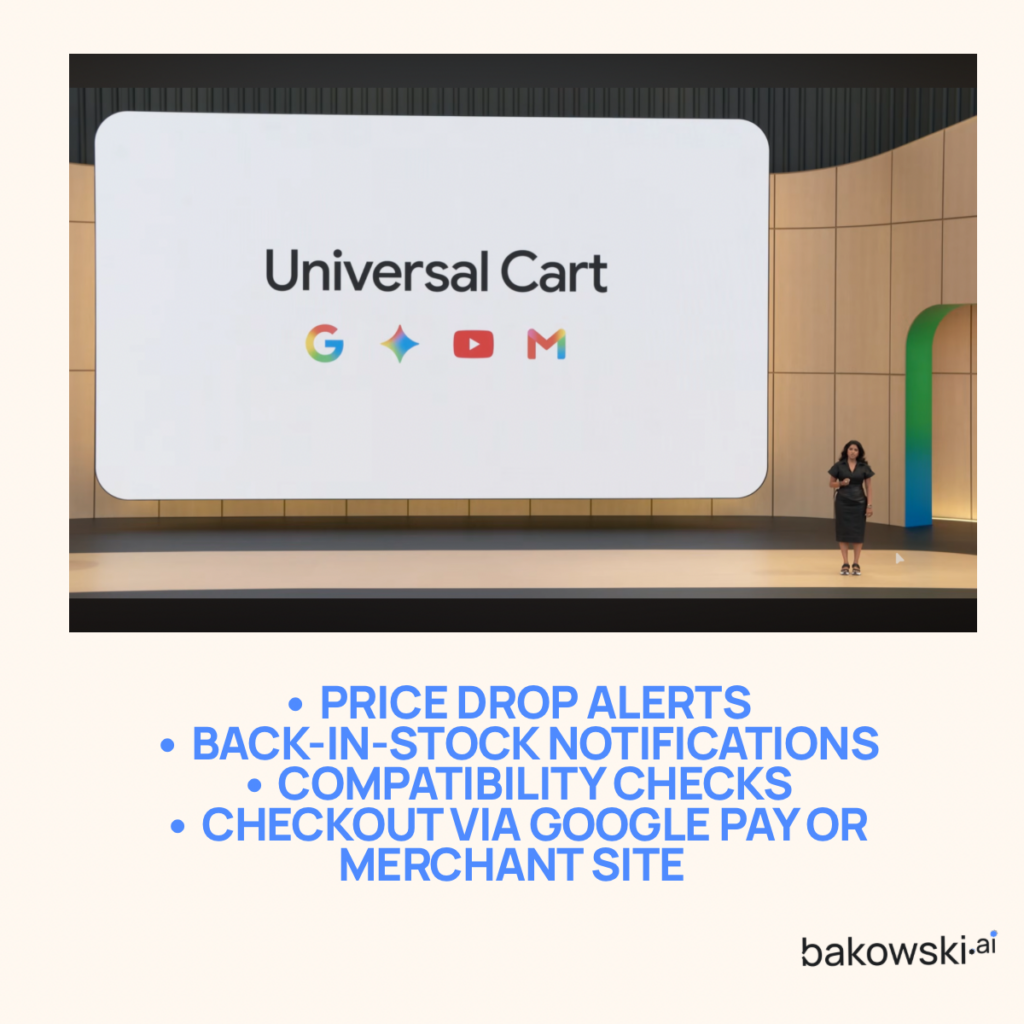
    This is the change that starts rolling out this summer in the US. Universal Cart is an intelligent shopping cart that works simultaneously across Search, Gemini, YouTube, and Gmail. Add a product while searching – the cart tracks price changes, notifies you when items come back in stock, flags compatibility issues, and offers checkout directly via Google Pay or a handoff to the merchant’s site.

    Launch partners include Nike, Sephora, Target, Ulta Beauty, Walmart, Wayfair, Fenty, and Steve Madden. Canada and Australia next, UK to follow. Hotels and local food delivery are also entering the UCP ecosystem.

    Universal Cart Google Features

    What This Means for Your Business

    Google is not just after top-of-funnel traffic anymore. It wants the full funnel – including the transaction. DTC brands: your website is no longer the only place a customer can buy from you. Marketplaces: UCP puts Google in the same position you are in – as an intermediary. With 2.5 billion monthly users in AI Overview and full payment infrastructure.

    Companies that sell purely on product without building additional value layers are in trouble. The era where Google decides who gets the customer is here.

  • Google Search Is Dead. AI Search Just Took Its Place

    Google Search Is Dead. AI Search Just Took Its Place

    At Google I/O 2026, the company announced what it calls “the biggest upgrade to the Search box in over 25 years.” That’s not marketing language. That’s Google officially closing the chapter on keyword search – a model that shaped how the entire internet was built. Here’s what actually changed, and what it means for your business.

    Google Just Admitted Keywords Were a Bad UX All Along


    For 25 years, users learned to speak Google’s language. Not “where can I have a client lunch in Warsaw without waiting in line” – just “restaurant Warsaw center”. We compressed our questions into fragments because that’s what the tool required.
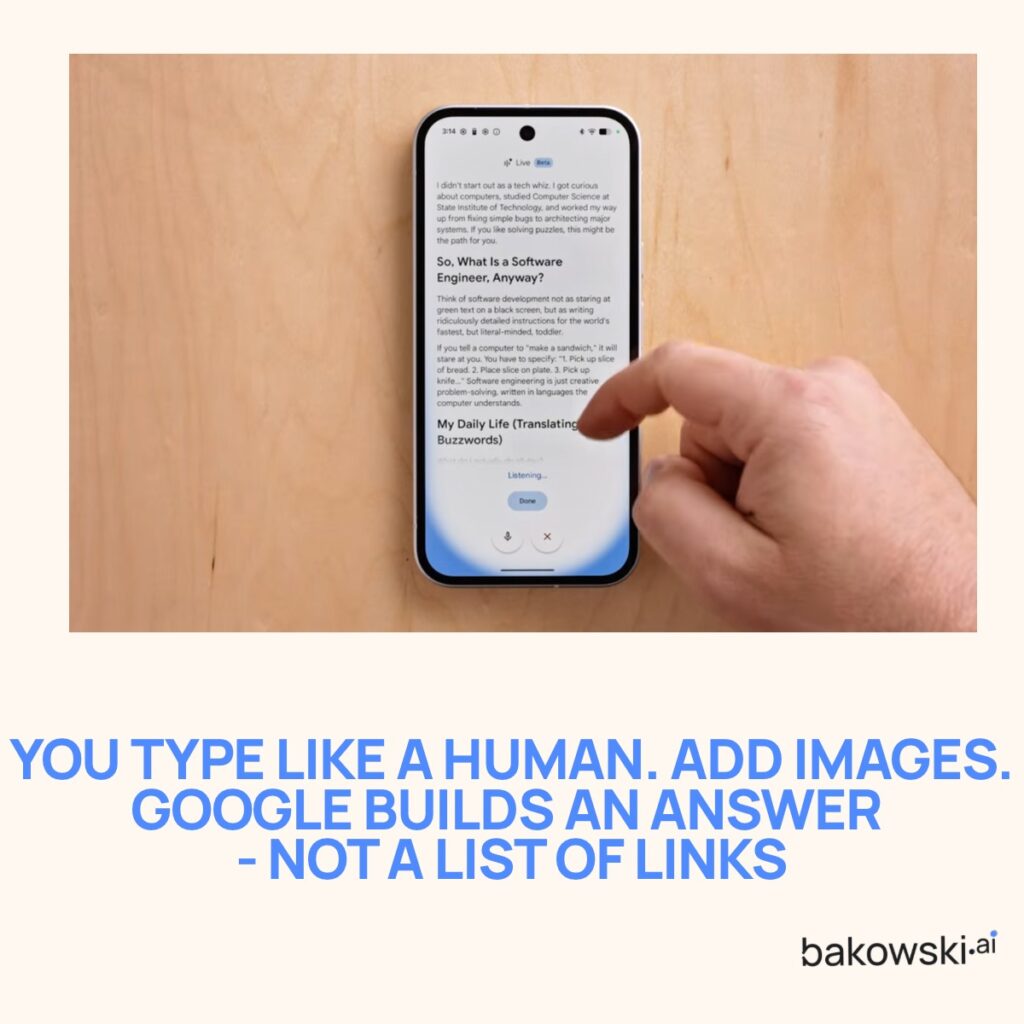
    The new search box simply expands to accommodate longer, more conversational queries – without forcing users to choose a mode or format. You type the way you think. Google stops being a search engine and becomes an interface to information.
    Users wanted this for years. Google couldn’t deliver it until now. The technology finally caught up.

    The Turning Point: Numbers That Explain the Timing

    Before getting into the specifics, some context that explains why Google moved now.
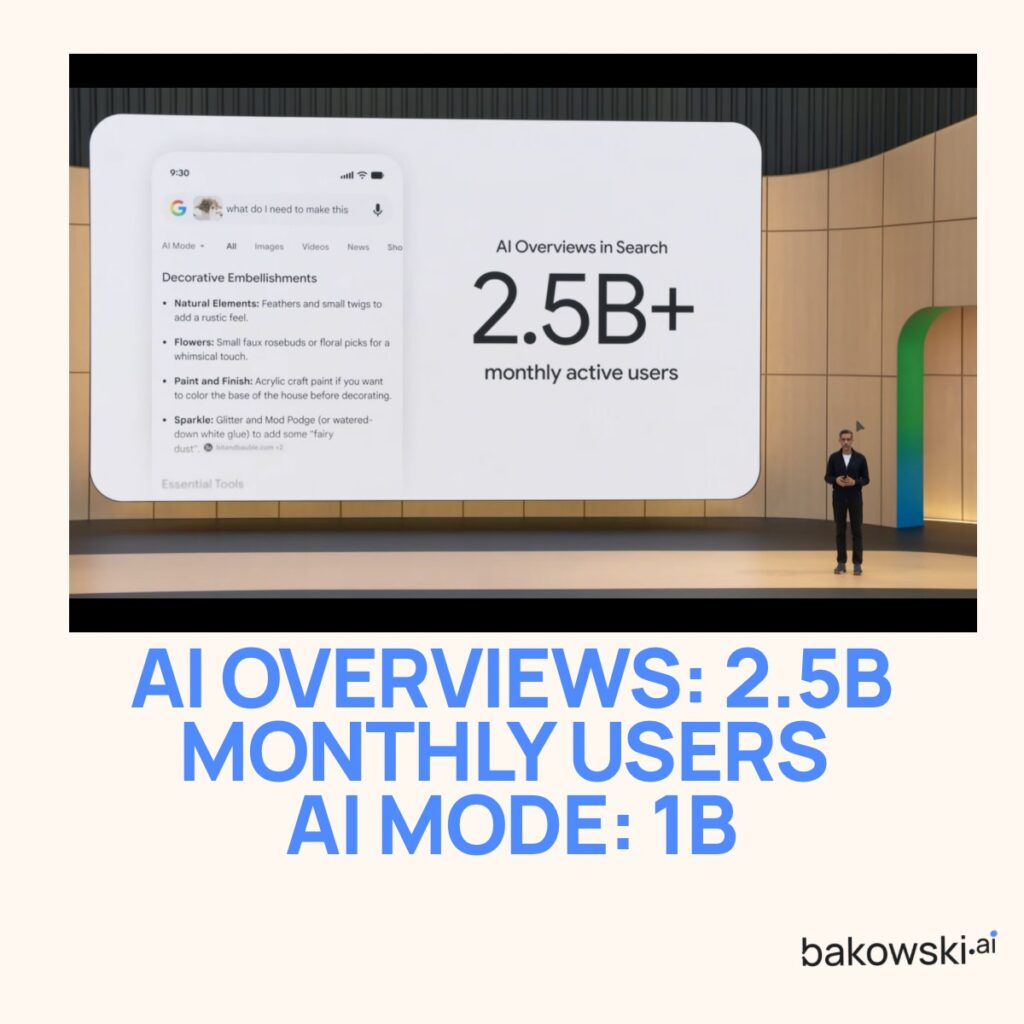
    AI Overviews – the AI-generated summaries that appear above traditional results – now reaches 2.5 billion monthly users. AI Mode, launched just a year ago, has crossed one billion monthly users, with queries more than doubling every quarter since launch.
    For comparison: ChatGPT had 900 million weekly active users as of February 2026. Google has more unique monthly users overall, but ChatGPT shows higher return frequency – meaning people come back to it multiple times per week.
    This is a race. And Google knows it can’t play defense.

    What Actually Changed – No Marketing Wrapper
    Three things that matter in practice:

    1. New search box – multimodal input
      Users can now include images, documents, videos and even open Chrome tabs as part of their search query. Ask about a company’s financials and attach their PDF. Ask for a recipe and drop in a photo of what’s in your fridge. This isn’t a future demo – it’s live globally, starting now.
    2. Information agents – background monitoring
      Starting this summer, users will be able to create and manage “information agents” that work in the background 24/7, tracking changes on the web and alerting users to new information. Google’s example: an agent monitoring market movements based on custom parameters.
      Think Google Alerts 2.0 – except instead of keyword matching, the agent understands context and filters out the noise.
    3. Generative UI – results as interactive tools
      Search results are starting to look more like interactive web pages than a list of links. Google builds the interface on demand, depending on what you’re searching for.

    What This Means for Publishers and Businesses
    The shift carries significant implications for publishers and the broader web ecosystem. If Google’s AI can synthesize information and build interactive tools, the incentive for users to click through to source websites diminishes further. Referral traffic from Google Search has already been declining as AI Overviews expanded – and the new features are likely to accelerate that trend.
    For SaaS, e-commerce, and content-driven businesses: SEO as “rank #1 on Google” is no longer the goal. The goal is being the source that AI cites and builds answers from.
    Those who don’t understand this shift within the next 12-18 months will be optimizing for a system that no longer exists.


    Google didn’t update its search engine. It changed the experience with users. For 25 years the experience was: “give me keywords, I’ll give you links.” The new experience is: “tell me what you want to achieve, and I’ll handle it.”
    For founders and marketers, this isn’t a reason to panic. It’s a signal that investment in quality content, first-party data, and genuine expertise will pay off more than ever. AI looks for valuable sources. Be one of them.