Article 50 of the EU AI Act applies from 2 August 2026. Most companies will respond in one of two ways: slap “AI-generated” on everything that came out of Canva, or do nothing and hope nobody checks. Both are wrong. The rule is narrower than people assume, but in one specific place it cuts far deeper. Fines: up to EUR 15 million or 3% of global turnover, whichever is higher.
Why this applies to companies that “don’t do AI”
The AI Act sorts AI systems by risk level. Prohibited practices sit at the top. Below them, high-risk systems – the ones used in recruitment, credit scoring, medical diagnostics, critical infrastructure. Those carry the heavy machinery: conformity assessments, technical documentation, CE marking. Most marketing and e-commerce businesses will never touch that category.
Article 50 works differently. It doesn’t ask about the system’s risk level. It asks about the situation you’re using it in.
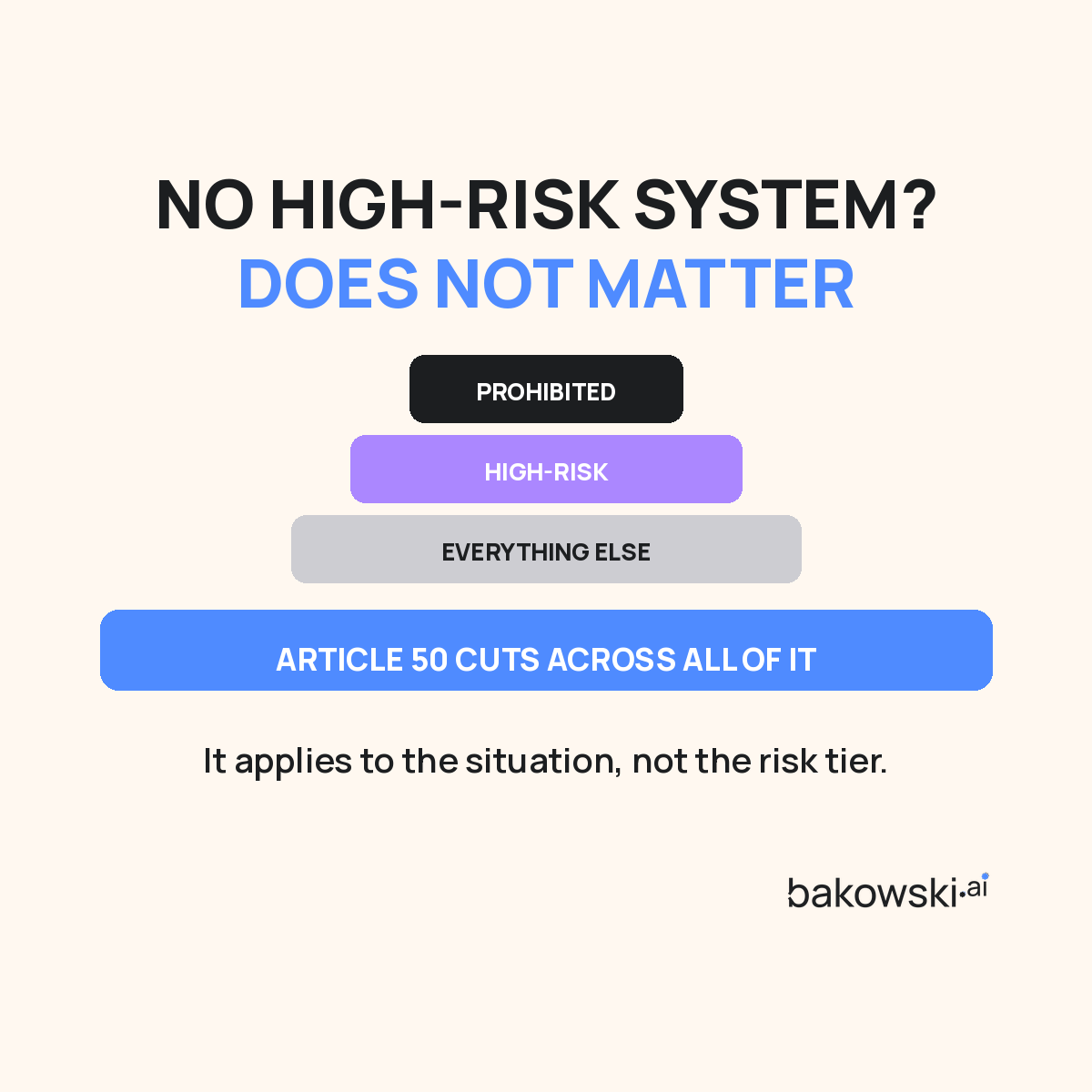
That’s why a company with zero high-risk systems can carry full Article 50 obligations – because it put a chatbot on its website or published an ad made in a video generator. According to Compliance Checker data from artificialintelligenceact.eu, transparency obligations are the second most common reason a business falls under the AI Act, right after AI literacy. They affect roughly a third of organizations surveyed.
This is a horizontal rule. It cuts across every industry and every risk tier.
Four situations. Only one is actually yours
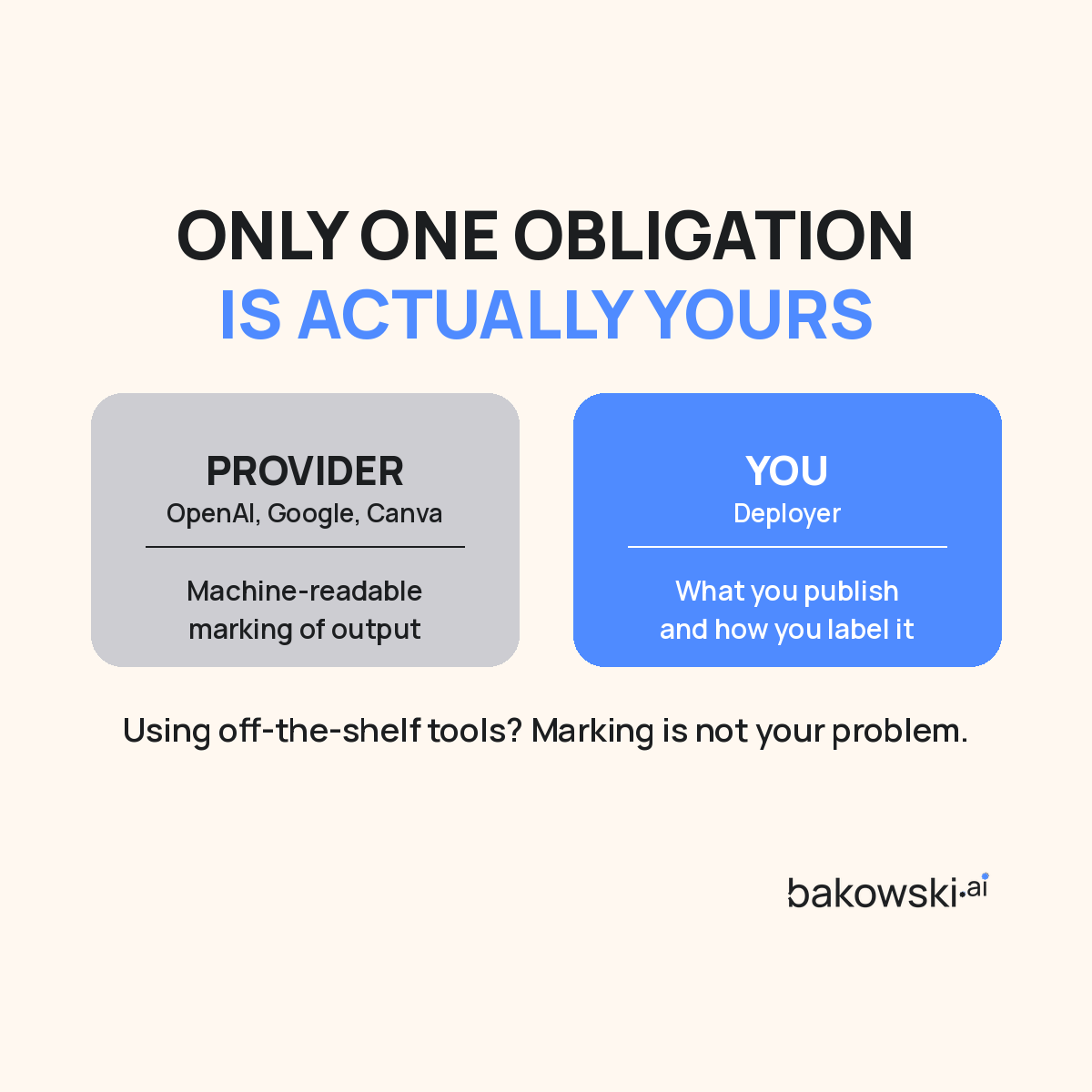
This is where the confusion starts. Article 50 covers four situations, but they don’t all land on the same party. Two are obligations of the tool’s provider. Two belong to the deployer – the business using the tool.
Situation one: AI interacts directly with a person. Chatbot, voice assistant, phone agent. The user has to know there’s a machine on the other end. That’s the provider’s obligation – whoever built the system and released it under their own brand.
Situation two: AI generates synthetic content – text, image, audio, video. The output must carry machine-readable marking so detection tools can identify it. Again, the provider’s job. Specifically: OpenAI, Google, Canva, Grammarly. Not you.
Situation three: AI recognizes emotion or performs biometric categorization. Anyone exposed to the system must be informed. This one falls on the deployer, but it affects a narrow set of businesses.
Situation four: deepfakes, and text published to inform the public on matters of public interest. Deployer’s obligation. And this is the one situation almost every content-publishing company lands in.
The practical takeaway: if you’re only using off-the-shelf AI tools, technical output marking isn’t your problem. What you publish, and how you caption it, is.
Deepfakes: the definition, and a five-second test
Under Article 3(60), a deepfake is AI-generated or AI-manipulated image, audio, or video content depicting a real person, place, object, or event, which would falsely appear authentic.
Everything turns on “authentic.” The question isn’t whether you used AI. It’s whether the viewer could take the material as a record of something that actually happened.
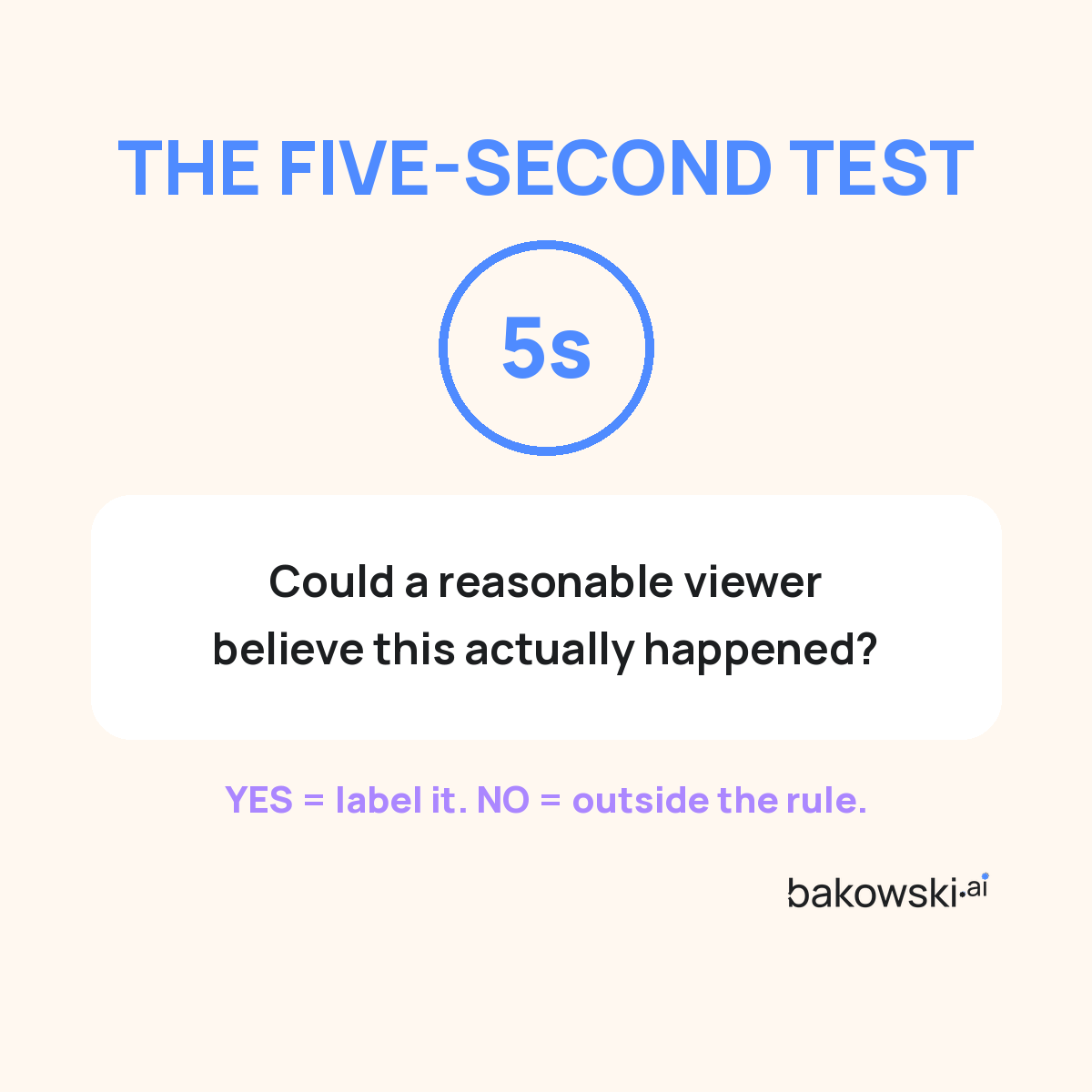
Hence the test: could a reasonable, attentive viewer believe this really occurred?
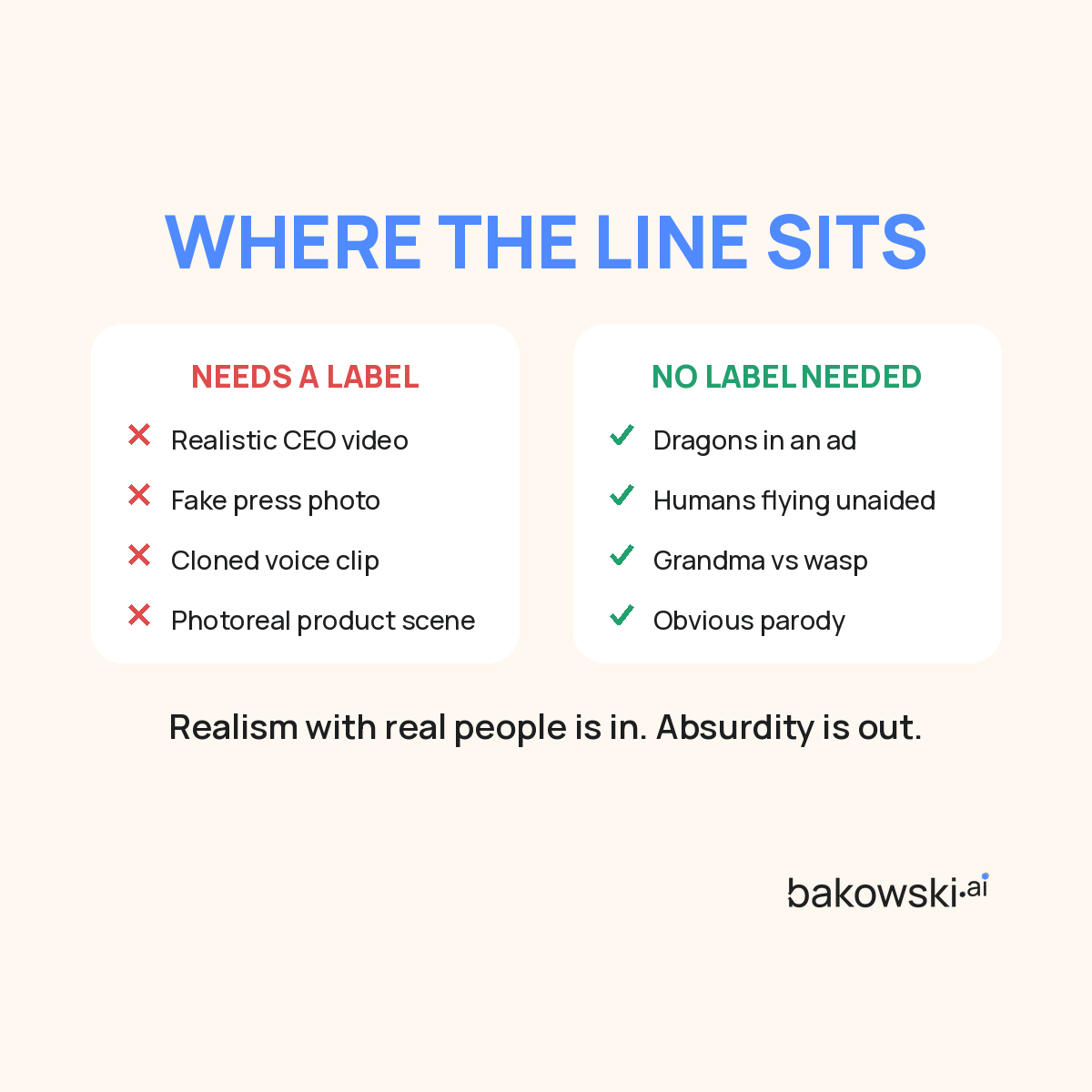
If yes, label it. If the scene is obviously fantastical or physically impossible, it falls outside the deepfake definition entirely. The Commission gives explicit examples: dragons, humans flying unaided, elephants driving cars. Separately, artistic, satirical, and fictional works get a lighter obligation – a disclosure that doesn’t spoil the work, not a badge stamped across the frame.
Where the line actually sits:
- Label it: a realistic video of a well-known CEO announcing a merger or layoffs. It looks like genuine footage, so it’s a deepfake.
- Label it: a photo of a politician in a situation that never happened, styled like an ordinary press image.
- Label it: a synthetic voice impersonating a real person in a clip that sounds like an authentic conversation.
- Label it: a photorealistic render showing your product in a scenario that never occurred, presented as a standard product photo.
- Don’t label it: an ad with a flying dragon or a person hovering unaided. Physically impossible, so outside the definition.
- Don’t label it intrusively: obvious parody recognizable as satire. A discreet note, for example in the caption, is enough.
A clean example of content entirely outside the risk zone: the short film “Grandma VS Wasp – Official 100% AI Made Story” from Higgsfield Creators, where a grandmother fights a wasp in full action-movie choreography. Nobody will read that as a record of real events, because people don’t duel wasps. On top of that, the creator declared it 100% AI right in the title. Absurdity plus explicit disclosure – two independent layers of protection.
Text plays by entirely different rules
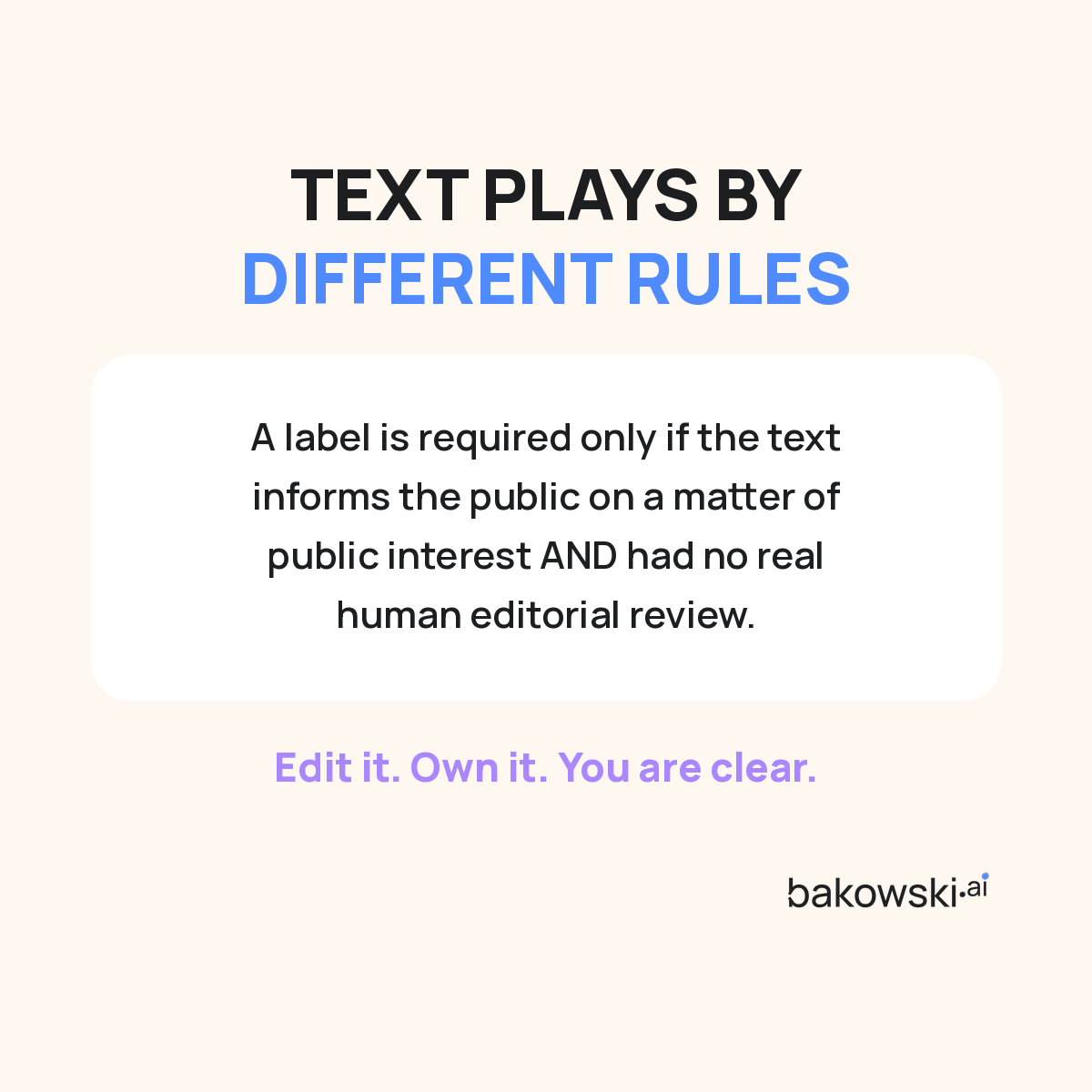
This is the most misread part of the rule, because intuition says that if images need labels, text must too. It doesn’t.
The obligation applies only to text published with the purpose of informing the public on matters of public interest. The publisher’s purpose is what triggers it, not the topic itself. A news article, a public report, a statement on a societal issue – yes. A product description, a company post, a sales newsletter – no.
On top of that, there’s a carve-out that lifts the obligation even from informational content: if the text went through genuine human review and a specific person or entity holds editorial responsibility, no label is required. The condition is that the review must be substantive. Clicking “approve” without reading doesn’t qualify.
In practice: draft with AI, edit it, own it – you’re clear. Publish raw model output verbatim on a public-interest topic with no editorial process – disclose it.
How to label so it actually works and doesn’t kill the message
The rule requires disclosure in a clear and distinguishable manner, at the latest on the recipient’s first exposure to the content. For video that means the start of the clip or a persistent badge. For audio, an audible notice. For images, a visible label.
A Code of Practice is being finalized in parallel to standardize this, proposing a uniform visual “AI” label and a split between fully AI-generated and AI-assisted content. The Code is voluntary, but it will function as the practical benchmark for regulators.
Wordings that meet the clarity threshold without sounding like a pharmaceutical warning:
- “AI-generated content” – universal, neutral, works anywhere.
- “Video created entirely with AI” – for content with no camera involved.
- “AI visualization. The people and situation are not real” – best for realistic scenes involving people.
- “Synthetic voice generated with AI” – for audio and voiceover.
- “AI-generated concept image” – for product visualizations.
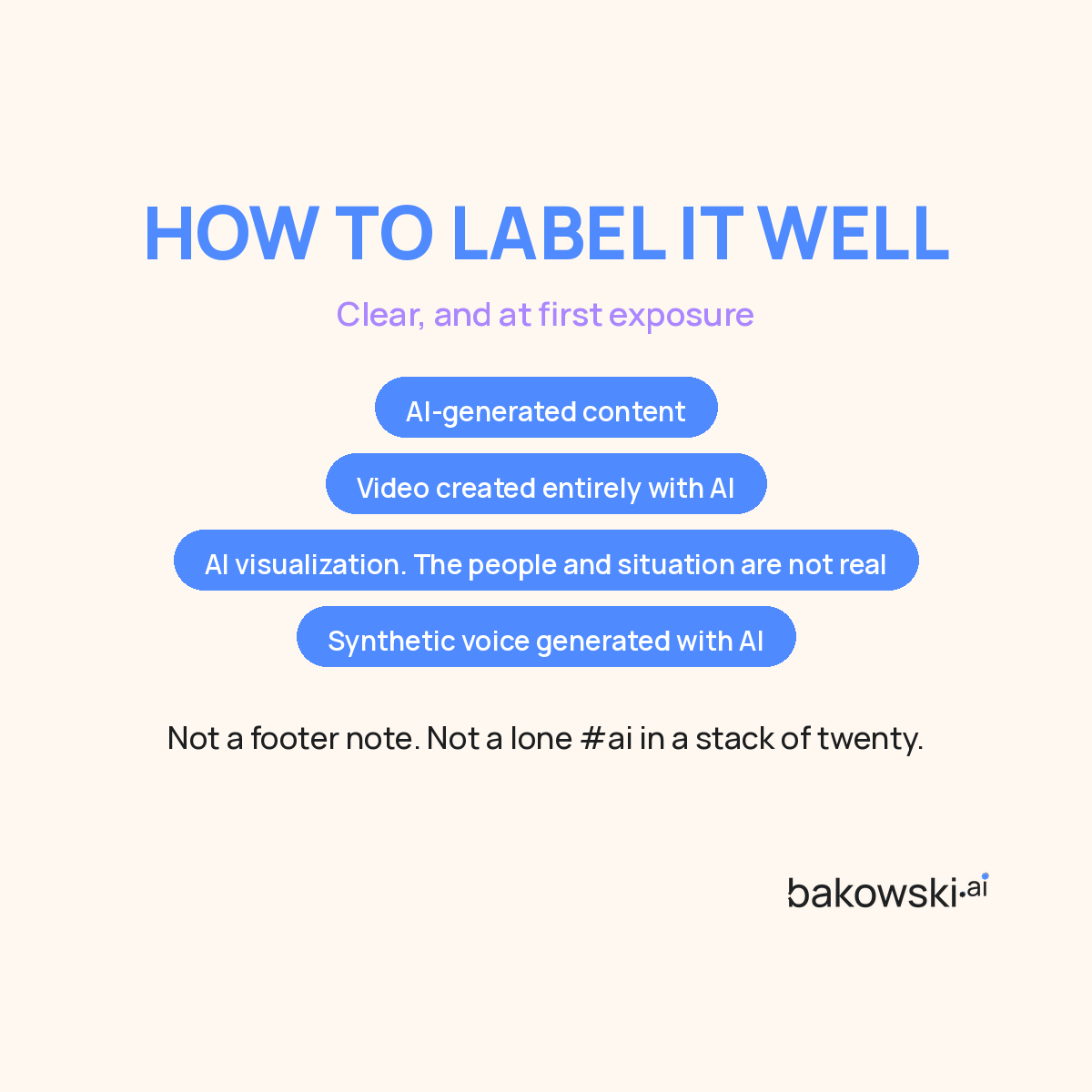
What to avoid, because it fails the clarity test: small print in the site footer, a note buried in the terms, a lone #ai at the end of twenty other hashtags, a badge flashing for a fraction of a second. The principle is simple: if the viewer has to look for it, it isn’t a disclosure.
Good news for marketing: transparency sells better than pretending. Brands that state plainly “made with AI” rarely lose trust. The ones that lose it are the ones caught hiding it.
Pre-August content, and the question nobody asks: who’s accountable for agency work
Two questions that decide, in practice, whether a company has a problem.
Previously published material: if a piece was both generated and published before 2 August 2026, no retroactive labeling is required. But if it was created earlier and you publish it on or after 2 August 2026, the obligation applies normally. Publication date governs, not creation date. That has a direct consequence for content banks and scheduled campaigns – anything sitting in the publishing queue falls under the new rules.
A separate transition period exists for providers: generative AI systems already on the market before 2 August have until 2 December 2026 to implement machine-readable marking. That’s an exception for tool builders, not for publishers.
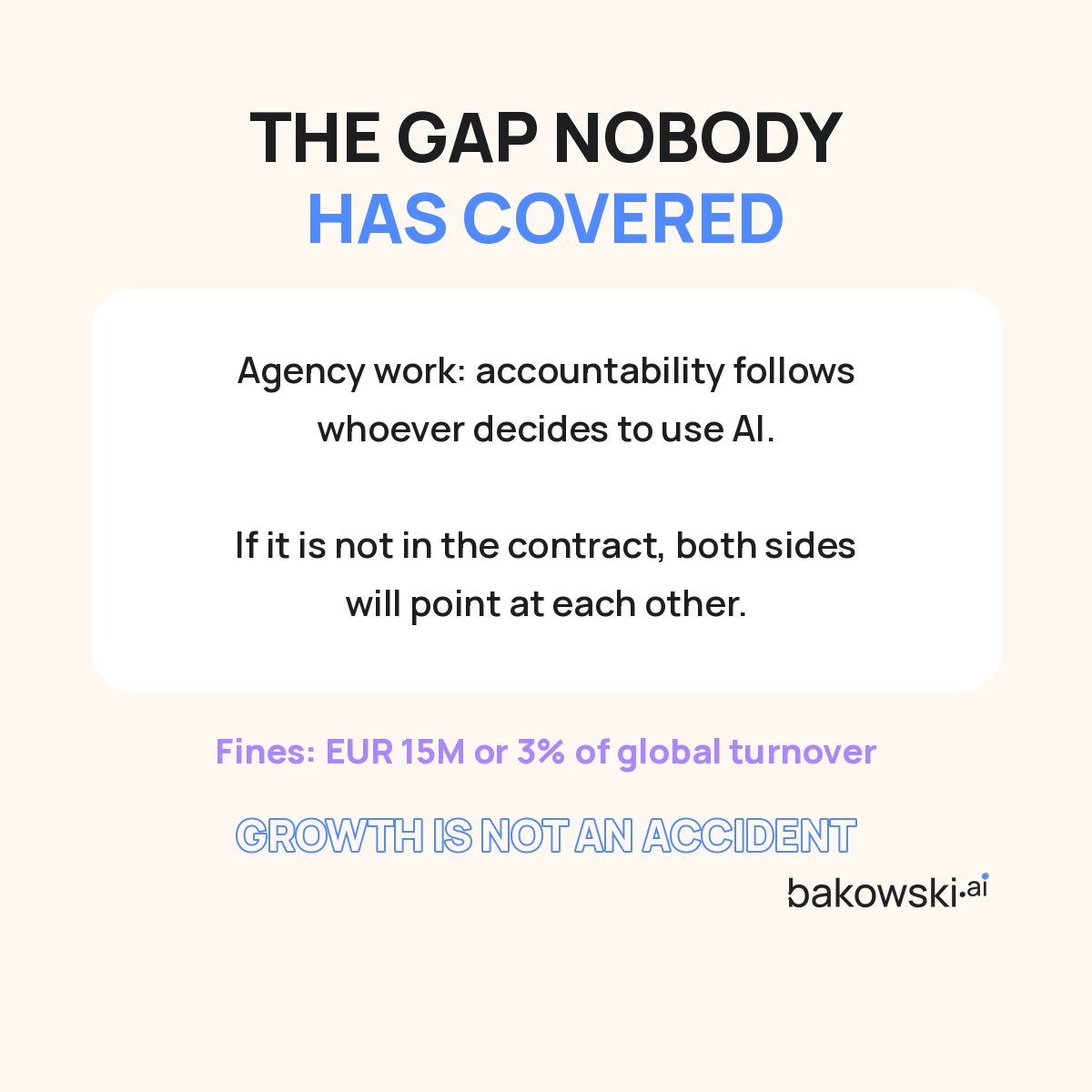
Agencies and freelancers: accountability follows the actual decision to use AI. If an agency works strictly to your brief and under your direction, your company remains the deployer and you’re accountable for labeling. If the contractor is free to decide whether and how to use AI on the assignment, they become the deployer and the obligation moves to them.
In practice, a content agency contract should now settle two things explicitly: who decides on AI usage, and who is accountable for labeling. Without that clause, the first time a regulator asks, both sides will point at each other.
What this means for your business
The AI Act doesn’t ban AI-generated content. It doesn’t tax creativity either. It forces one thing: that the audience knows when they’re looking at reality and when they’re looking at a simulation of it.
For most companies the actual work is small but specific. This isn’t a quarter-long compliance program. It’s a review of three things: what you publish, who makes it, and how you sign it.
The risk isn’t where companies are looking for it. Nobody gets fined for an unlabeled blog graphic. The fine comes from a realistic piece featuring a real person that went out with no indication it was synthetic – and from having nobody inside the organization who owns that process.
Three things to remember
The deepfake test is a credibility test, not a technology test. The question isn’t “did I use AI,” it’s “could someone take this as true.” Absurdity and fantasy sit outside the rule. Realism involving real people sits inside it.
Human-edited text needs no label. The obligation covers only content published to inform the public, and it disappears when real editorial responsibility exists. The editorial process is your shield here, not a formality.
Publication date settles old content, and the contract settles agencies. Anything going out on or after August 2 falls under the new rules regardless of when it was made. And accountability for labeling sits with whichever side decides on using AI.
This rule doesn’t change what you’re allowed to create. It changes what you’re not allowed to leave unsaid. Growth is built on systems and deliberate decisions – and this is one you make once and write into the process.
Note: this article is informational and does not constitute legal advice. Before implementing specific measures, confirm the final interpretation with your legal team or a lawyer specializing in AI regulation.